Why Pain Doesn’t Always Mean You Should Stop Movement
Let me start by saying something that might surprise you. Pain does not always mean damage. This is one of the most important things I tell my patients. Your body can produce pain as a warning signal. But that signal does not always mean something is broken.
Think of it like a smoke alarm. Sometimes the alarm goes off because of real fire. Other times it goes off because you burned your toast. Your pain system works in a similar way. It can become overly sensitive — especially with chronic pain.
Research published in Neuroscience and Biobehavioral Reviews found that exercise training actually increases your pain threshold (Belavy et al., 2021). That means the more you train — within safe limits — the better your body becomes at managing pain. Your nervous system starts to turn down the volume on those alarm signals.
This effect is called exercise-induced hypoalgesia. A review in the European Journal of Applied Physiology confirmed that after a single session of exercise, pain sensitivity decreases at the joints being used (Tomschi et al., 2022). Your body has its own built-in pain relief system. Movement helps switch it on.
So when you feel that achy pain in your upper back or tightness in your neck — movement may be exactly what you need. The trick is knowing how much to do.
Understanding Your Pain: Dull Pain, Tightness, and When to Modify
Not all pain is the same. This matters when deciding how to exercise. Let me break it down simply.
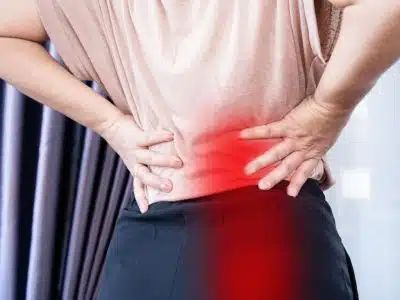
A dull pain or achy pain is usually your muscles or joints telling you they are under load. This kind of discomfort is often safe to work through — gently. Tightness in your neck, upper back, or lower back often responds well to movement.
Sharp pain that gets worse with activity is different. If your pain increases during exercise and stays elevated afterward, that is your body saying too much. This is where the “pain monitoring model” comes in.
A landmark study by Silbernagel and colleagues (2007) in the American Journal of Sports Medicine introduced this idea. They found that patients with Achilles injuries could keep running and jumping during rehab. The rule was simple. Your pain should stay at or below a 5 out of 10 during activity. It should not increase from week to week. And it should return to your baseline by the next morning.
This same principle applies to your lower back pain, neck stiffness, or any injury. You can keep moving. You just need to respect the boundaries your body sets.
How to Modify Your Training Loads to Build Strength Without Aggravating Injuries
Here is where things get practical. Modifying your training does not mean giving up. It means training smarter.
A systematic review in BMJ Open Sport & Exercise Medicine found that the most common approach to exercise progression in tendon injuries uses pain as a guide (Escriche-Escuder et al., 2020). If your pain stays manageable, you gradually increase the load. If it flares, you step back slightly. This is called progressive loading.
Imagine you are building a house. You would not put the roof on before the walls are strong enough. Your body works the same way. You build load gradually so your muscles, tendons, and joints can adapt.
Here are some practical ways to modify your training. If running causes your lower back to ache, try switching to a softer surface like grass or a treadmill. If heavy squats flare your knee, reduce the weight and slow the movement down. If your neck pain increases with overhead pressing, try a seated version with lighter loads.
The key is that you keep progressing. A meta-analysis in the Journal of Personalized Medicine showed that resistance training significantly reduces pain and improves strength in people with joint pain (Kim et al., 2024). You do not get stronger by resting. You get stronger by loading your body in a way it can tolerate — and then gradually asking for more.
Changing Surfaces and Exercises: Small Adjustments, Big Gains in Pain-Free Movement
Sometimes your injury does not need a complete rest. It needs a different environment.
Running on concrete puts significantly more stress through your lower back, hips, and calf muscles than running on grass or a trail. If your achy pain or tightness flares on hard surfaces, switching to softer ground can let you keep running. The same goes for gym exercises. A leg press might be kinder to your knees than a barbell squat. A cable row might feel better for your neck than a heavy barbell row.
Research on chronic lower back pain in Frontiers in Public Health found that multiple types of exercise can reduce pain — from resistance training to water-based exercise (exercise prescription review, 2025). What matters is that you find the version that works for your body right now. You can always return to harder versions later.
The goal is never to stop moving. The goal is to move in a way your body can handle today while building toward what it can handle tomorrow.
How a Chiropractor Uses a Multimodal Approach to Help Your Tendon Injuries and Strength
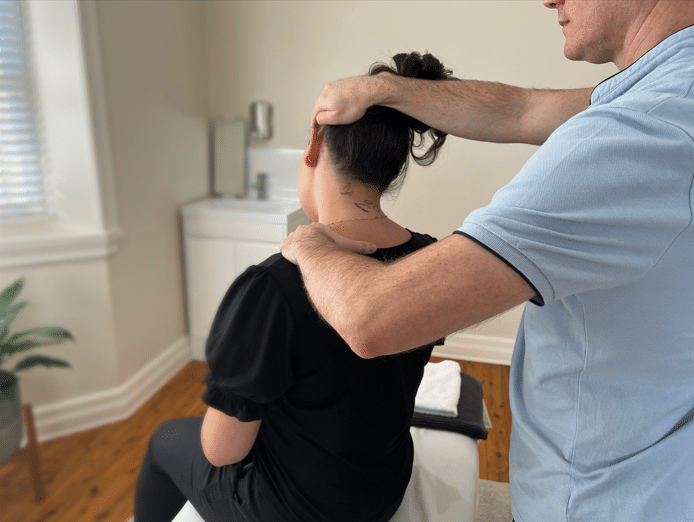
This is where I get excited. As a chiropractor, I do not just crack backs. I use a multimodal approach that combines soft tissue therapy, chiropractic adjustments, and targeted exercise prescription. And the evidence supports this combination.
The 2024 Clinical Practice Guidelines from the Academy of Orthopaedic Physical Therapy recommend multimodal treatment for tendon injuries (Chimenti et al., 2024). This means combining hands-on therapy with progressive loading exercises gets better results than exercise alone. A review in Frontiers in Pain Research also found that the combination of spinal manipulation and exercise provides the strongest evidence for managing neck and lower back pain (Gevers-Montoro et al., 2021).
Here is how this works in practice. Soft tissue therapy addresses the tightness and muscle tension around your injury. Chiropractic adjustments restore normal joint movement. Then exercise builds the strength your tendons and muscles need to handle load.
A 2024 systematic review of gluteal tendinopathy confirmed that exercise-based interventions improve both pain and function (Cordeiro et al., 2024). But getting the exercise dosage right is critical. Too little and your tendons do not adapt. Too much and your symptoms flare.
This is exactly what a chiropractor trained in exercise prescription can help you with. I prescribe the correct exercise type, the right number of repetitions, and the appropriate load. Then I progress it at the pace your body can handle. Think of it as having a personalised blueprint for your recovery.
The Connection Between Your Lower Back, Pelvis, Hips, and Calf Muscles: Why Pain Travels
Here is something many people do not realise. Your lower back, pelvis, hips, and calf muscles are all connected through a system called the kinetic chain. A weakness or problem in one area can cause pain in another.
Think of your body like a chain of dominoes. If one domino falls out of position, the ones next to it are affected. The lumbopelvic-hip complex is the central link in this chain. It connects your upper and lower body. When it does not work well, everything above and below it compensates.
A systematic review in Sports Medicine Open showed that weakness in the posterior chain muscles — including the glutes, hamstrings, and lower back — is directly linked to chronic lower back pain (Catterall et al., 2021). When your glute muscles are weak, your lower back works overtime. This extra load can cause dull pain and tightness in your lumbar spine.
But it does not stop there. Weak hips also change how your pelvis moves. This alters the load on your hamstrings and calf muscles. Clinical practice guidelines now recommend assessing hip and knee strength in patients with Achilles tendon pain (Chimenti et al., 2024). Your calf injury might actually be driven by a hip or lower back problem.
This is why a thorough chiropractic assessment looks at the whole chain — not just where it hurts. If your calf is tight and your Achilles is sore, I will also check your hip strength, pelvic alignment, and lower back movement. Fixing only the painful spot without addressing the cause is like putting a bandaid on a leaking pipe.
Lower Back and Neck Pain: How Movement and Chiropractic Care Work Together
If you deal with lower back pain or neck pain, you are not alone. Spine pain affects more than 11% of the global population (Gevers-Montoro et al., 2021). It is the single leading cause of activity limitation worldwide.
But here is the good news. The research is clear that movement — combined with manual therapy — is one of the best things you can do for it. A recent meta-analysis of 27 studies found that resistance training significantly improves pain, strength, and function in people with joint problems (Kim et al., 2024). And importantly, these benefits were seen at all time points — from four weeks through to nine weeks and beyond.
When it comes to your neck, a narrative review in Sports Medicine and Health Science found that therapeutic exercise can trigger pain-relieving effects even after a single session (Rojas-Galleguillos et al., 2024). Your neck tightness and dull pain respond to the right movement. But you need guidance on what to do and how much to do.
That is where chiropractic care fits in. I combine hands-on treatment to reduce your pain and stiffness with a structured exercise plan to build long-term resilience. The goal is not just to get you out of pain today. It is to make sure you stay out of pain tomorrow.