- 02 9712 1736
- [email protected]
- 212 Great North Road, Five Dock, NSW 2046
- Open 7 days a week

If the idea of a sudden twist and a loud crack makes you tense up, you are not unusual. Plenty of people who would benefit from hands-on care never book it, because the version of chiropractic they picture feels too rough for their body or their nerves. Low-force chiropractic care is the gentler end of the same profession. Here is what it actually involves, what the research says about how well it works, and who it suits best, including older adults, people with osteoporosis, pregnant patients, and anyone who simply does not want to be cracked.

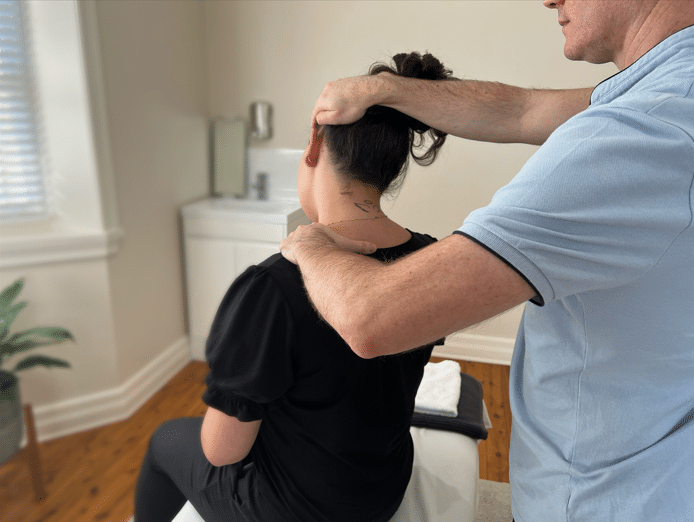
Low-force care is not a single technique. It is a family of approaches that share one goal: change how your joints and muscles behave without a fast thrust at the end of the movement.
In practice, that includes slow, rhythmic joint mobilisation, drop-piece tables that absorb most of the load, flexion-distraction on a table that gently opens the low back, hand-held adjusting instruments that deliver one small tap, and soft tissue or body work on the muscles around the joint. Research trials in older adults describe exactly this mix, with practitioners choosing between a standard adjustment, a low-velocity low-amplitude adjustment, flexion-distraction or drop-table work depending on what each person could tolerate (Schulz and colleagues, Chiropractic & Manual Therapies, 2019). So low-force care is best understood as a dial rather than a switch, and part of our job is deciding where on that dial your spine sits today.
A traditional adjustment is called high-velocity, low-amplitude. The “high velocity” part is the key. Your practitioner takes the joint to the end of its available range, then applies a quick, shallow push.
How quick, and how hard? A scoping review of 66 studies measuring the mechanics of spinal manipulation found peak forces ranging from 17 to 1213 newtons across all spinal regions, with the force building in as little as 12 milliseconds (Gorrell and colleagues, Chiropractic & Manual Therapies, 2023). Neck techniques sat at the lower end, around 41 to 407 newtons, while mid-back techniques reached the highest values. That review also found something clinically important: the ranges are enormous, and only one in five studies reported the accuracy of their measuring equipment, so “how much force is normal” is genuinely not a settled number.
Low-force techniques deliberately sit at the bottom of that range. Graded mobilisation, for example, produces roughly 2 to 500 newtons depending on how firmly it is applied (McArthur and colleagues, Physical Therapy Reviews, 2021). The other difference is speed. Gentle work is slow and repeated, so your nervous system has time to respond instead of being surprised.
And the crack? That sound is a gas bubble effect inside the joint, not a bone moving back into place. It is worth knowing that most people believe otherwise. In a survey of 478 Italian adults, beliefs about what the pop means largely disagreed with current scientific explanations, agreement was high that a successful treatment should produce a pop, and 31% of those who had been manipulated said nobody had ever explained the technique to them (Bergamino and colleagues, Journal of Manipulative and Physiological Therapeutics, 2022). No pop does not mean no treatment. It usually just means a different technique.
This is where we want to be straight with you, because the honest answer has two halves.
For sudden, recent low back pain, one randomised trial compared manual thrust manipulation with instrument-assisted manipulation and with usual medical care in 107 adults. At four weeks, the hands-on thrust group did better than the instrument group, by 8.1 points on a 100-point disability scale and 1.4 points on a 10-point pain scale (Schneider and colleagues, Spine, 2015). By three and six months, though, those differences had disappeared, and no group was clearly ahead. So for a fresh episode of back pain in a healthy adult, a firmer technique may get you comfortable faster, while the twelve-month picture looks similar either way.
Now the other half. A carefully screened review of manual therapy trials identified one study of 150 people with chronic low back pain that compared a high-velocity thrust with flexion-distraction, a gentle table-based technique, both combined with trigger point work. Immediately afterwards, the flexion-distraction group had larger reductions in pain and larger increases in pressure pain thresholds, meaning the tissue was less tender to pressure (Riley and colleagues, Journal of Manual and Manipulative Therapy, 2023). The reviewers were careful to point out that the disability difference of 5.1 points fell below the 9.5 points considered clinically meaningful, and that the measurements were taken immediately, with no follow-up.
Putting those two studies side by side gives you the practical takeaway. For acute pain, force may buy you a little speed; for long-standing pain that is already sensitive to touch, gentler input may be the more comfortable and equally reasonable path. That is one reason we assess and re-assess rather than committing to one technique for your whole course of care.
Do you feel like your back is more stiff than sore, with a dull, achy pain that builds through the day? That pattern is very common as spinal joints change with age, and it is one of the clearest reasons to turn the force down.
A systematic review of manipulation in people aged 65 and over pooled five randomised trials with 676 participants and a mean age of 77. It found no significant differences in outcomes between high-velocity techniques and modified, lower-force techniques, and reported no adverse events linked to either approach (Bagagiolo and colleagues, BMJ Open, 2025). The review could not run a meta-analysis, because the five trials were too different from each other to combine, so read that as reassurance rather than proof.
Effect sizes in this age group are modest, and we would rather you knew that up front. In a trial of 241 adults aged 65 and over with chronic low back pain, adding chiropractic care to a home exercise program produced a 0.78-point advantage on a 10-point pain scale at 12 weeks, and that advantage was gone by 26 and 52 weeks (Schulz and colleagues, 2019). Pain fell by roughly 30 to 40% in every group, including the exercise-only group. A smaller feasibility trial of instrument-assisted care for dizziness and neck pain in 24 community-dwelling older adults found trends favouring treatment but no statistically significant differences, and it was never designed to prove effectiveness (Kendall and colleagues, Chiropractic & Manual Therapies, 2018).
Here is what that means for you in practice. Exercise is doing much of the heavy lifting, so gentle treatment works best as the thing that makes moving possible rather than as the whole plan. It also explains why we test your balance, walking and step timing, not just your sore joint. Age-related changes reduce the accuracy of the position sense your spine and legs send to your brain, which is called proprioception, and that sense is what keeps you steady when you turn quickly or step off a kerb.
On safety, an updated systematic review of 25 studies of chiropractic care in adults over 55 recorded 412 treatment-related adverse events, of which nine were severe and none were catastrophic (Daniels and colleagues, Chiropractic & Manual Therapies, 2026). Most reported events were short-lived soreness. Notably, no case reports described harm following soft tissue techniques, exercise or other gentle modalities. That review also could not separate low-force from high-velocity technique in its data, so it tells us chiropractic care in older adults is broadly low-risk without proving low-force is safer.
If you have osteoporosis, or you have been told your bone density is low, your question is probably simple: could an adjustment break something?
The reassuring part of the picture is mechanical. A narrative review of the biomechanical and clinical literature reported that graded spinal mobilisation produces forces of roughly 2.2 to 499.8 newtons, while the loads at which vertebral components fail in laboratory testing sit between 200 and 727 newtons (McArthur and colleagues, 2021). Those ranges overlap at the top end, and that overlap is exactly why we do not use firm techniques on a fragile spine. The same review found only one case study and three randomised trials of spinal manual therapy in people with osteoporosis, with no serious adverse events reported, and concluded that the literature is too limited to draw firm conclusions about either safety or benefit.
So we will not tell you that gentle chiropractic care is proven safe in osteoporosis, because that evidence does not exist yet. What we will say is that the review found forces vary widely between practitioners depending on the region treated and the person on the table, which makes deliberate, measured, low-force technique the sensible default. In practice we ask about fracture history, bone density scans and medications first, keep our hands away from thrust techniques over the thoracic spine, and lean on soft tissue work, gentle mobilisation and loading exercise instead.
Pregnancy changes your load, your ligaments and your centre of gravity, often all at once, and low back or pelvic girdle pain follows for a large proportion of expectant mothers. Lying face down stops being an option, and firm rotational techniques become inappropriate, so pregnancy care is almost always low-force care with pillows, side-lying positions and pregnancy tables.
The evidence here is thinner than the marketing around it. A systematic review of 50 articles on chiropractic care for pregnancy-related low back pain, pelvic girdle pain or both graded the evidence for chiropractic care as inconclusive but favourable, and the evidence for spinal manipulative therapy specifically as inconclusive with unclear strength (Weis and colleagues, Journal of Manipulative and Physiological Therapeutics, 2020). Exercise and multimodal care fared similarly, with favourable but inconclusive ratings. A randomised trial of 56 Norwegian women with dominating one-sided pelvic girdle pain found sick leave rates of 38% in the treated group versus 53% in the control group late in pregnancy, but the difference was not statistically significant, and pain and disability scores were comparable between groups (Gausel and colleagues, BMC Pregnancy and Childbirth, 2017).
That is a genuinely mixed result, and we think you deserve to hear it that way. Gentle care during pregnancy is a reasonable option for comfort and mobility, and it has not been shown to cause harm in these trials, but it is not a proven way to prevent time off work or to change the course of pelvic girdle pain. We work alongside your midwife, GP or obstetrician rather than in place of them.
Some people avoid treatment because of the technique rather than the pain. That includes patients who cannot face dry needling. Needle fear is far more common than most clinics assume: in an international survey of 2098 adults, 63.2% reported needle fear, and about a third of those said they had avoided a vaccination because of it (Alsbrooks and Hoerauf, PLOS ONE, 2022). Others are wary of the crack itself, which fits with survey findings that many people misunderstand what the sound is and that roughly a third were never given an explanation of the technique used on them (Bergamino and colleagues, 2022).
We need to flag something honestly here. We could not find trials testing whether low-force chiropractic produces better outcomes specifically in anxious or needle-phobic patients, so the argument for it is reasoning rather than direct evidence. What the research does support is narrower and still useful: needle fear is common and often unspoken, and beliefs about manipulation are frequently inaccurate and poorly explained. Those are both fixable with conversation.
So what we offer is practical rather than evidence-branded. Nothing happens without your consent, dry needling is optional and never assumed, we explain and demonstrate a technique on your hand or forearm before using it on your spine, and if you would rather never hear a pop, we simply do not use techniques that produce one.
Why combine soft tissue therapy, gentle adjustments and exercise instead of picking one? Because pain does not only hurt, it changes how you move.
When an area is painful, your nervous system protects it. Muscles guard, movement gets cautious, and you unconsciously avoid the range that feels risky. Physiotherapists watching people with chronic low back pain move described this guarding as a distinct quality: caution about movement that was separate from simple stiffness or slowness (Williams and colleagues, European Journal of Pain, 2024). This protection is not one-size-fits-all, though, which is a nuance we take seriously. A review of motor control in low back pain concluded that some people move with excessively tight control while others move with unusually loose control, and that averaging the two hides the real problem (van Dieën and colleagues, Journal of Orthopaedic and Sports Physical Therapy, 2019). An experiment that induced short-term back pain in healthy volunteers even found trunk stiffness decreased and damping increased during pain, rather than everything simply tightening up (van den Hoorn and colleagues, Journal of Biomechanics, 2020).
Here is what this means for you in practice. We do not assume your tightness needs loosening. If your protective pattern is over-braced, easing muscle tightness and restoring range comes first; if it is under-controlled, we build strength and control before we chase mobility.
Each ingredient has its own honest evidence. Soft tissue work helps: a meta-analysis of eight trials in 375 people with chronic low back pain found myofascial release improved pain and physical function against control, with a stronger effect against sham, but adding it on top of manipulation or exercise produced no extra benefit in those subgroups (Wu and colleagues, Frontiers in Medicine, 2021). Manual therapy also appears to reduce local tenderness, as in the flexion-distraction comparison above, where pressure pain thresholds rose more with the gentle technique (Riley and colleagues, 2023). Exercise carries the strongest signal of the three: a Cochrane review of 249 trials found exercise reduced pain by 15.2 points compared with no treatment, usual care or placebo, a clinically important difference, while its effect on function was smaller (Hayden and colleagues, Cochrane Database of Systematic Reviews, 2021). And the combination has been tested as a package: adding chiropractic care, including manipulation, rehabilitative exercise and other manual therapies, to usual medical care in 750 US service members improved pain by a further 1.1 points and disability by 2.2 points at six weeks, with no serious adverse events (Goertz and colleagues, JAMA Network Open, 2018).
So the reasoning holds together. Hands-on work reduces the tenderness and guarding that make movement feel unsafe, and exercise then rebuilds the strength and confident movement that keep the protective response from switching straight back on. What we cannot tell you is how much each ingredient contributes, because the trials testing the package have not dismantled it.
Exercise only helps at the right dose. Too little changes nothing. Too much flares your pain for days and confirms your nervous system’s suspicion that movement is dangerous.
This is where a chiropractor earns their keep, and there is real data to steer by. A Bayesian network meta-analysis of 82 trials and 5033 adults with chronic low back pain found a non-linear dose-response curve, with meaningful pain improvement from about 520 MET-minutes per week and the largest effect near 920 MET-minutes, though certainty ranged from very low to moderate (Liang and colleagues, Journal of Orthopaedic and Sports Physical Therapy, 2024). A separate meta-regression of 50 trials and 2786 patients found that stabilisation exercise worked best at 20 to 30 minutes per session, three to five times a week, with an inverted-U pattern — more was not better (Mueller and Niederer, Scientific Reports, 2020).
Read together, those two analyses say something useful: there is a middle band where exercise reduces pain, and both under-dosing and over-dosing cost you. Neither analysis tells us the right starting dose for your particular back, and the certainty grades are honest about that. So we set your starting load from what we find on assessment, then adjust it based on how you respond over the next 24 to 48 hours.
What about low mood and anxiety? Persistent pain, poor sleep and low mood travel together, and less pain plus more confident movement genuinely helps you feel more like yourself. But we will not claim that a gentle adjustment treats your mood. The trials above measured pain, disability and tenderness — not depression or anxiety — and the honest position is that easing muscle guarding and tightness is a physical goal with physical evidence behind it. If low mood or anxiety is a major part of your picture, we work alongside your GP or psychologist.

Low-force chiropractic care means slow mobilisation, drop-piece and flexion-distraction tables, hand-held instruments and soft tissue body work instead of a fast thrust. It is a genuine option rather than a watered-down one, and for a fresh episode of back pain a firmer technique may work slightly faster in the short term, while long-term results look similar.
Gentle care is the sensible default if you are older, have low bone density, are pregnant, or simply do not want to be cracked. The evidence for it in those groups is reassuring on safety but thin on effectiveness, and we would rather say so than oversell it. Combining hands-on work with graded exercise at the right dose is the part with the strongest support, because easing protective muscle guarding and tightness is what lets you rebuild strength and movement.
If your pain, stiffness or injuries have not settled, get properly assessed — and tell us up front how gentle you need us to be.
This article is general information only. It is not a substitute for an individual assessment by a qualified health practitioner. If you are worried about your back, neck or bone health, please book an appointment or speak with your GP.

Scott has more than 20 years of clinical experience as a movement expert and musculoskeletal health professional. His thorough understanding of how pain affects your spine, joints, muscles, and total well-being is the result of significant academic study and many many years of clinical experience. Scott’s real interest in movement mechanics enables him to develop individualised care plans that summarise complex problems into clear, simple treatments, leading to quicker healing times. His friendly, attentive approach ensures that you not only comprehend but also feel supported throughout your treatment journey, allowing you to return to the things you like with restored confidence and vitality.