Why tennis elbow pain can linger long after the injury
You may have noticed your pain no longer matches what you do. A light coffee cup can hurt as much as a heavy shopping bag.
That pattern makes sense once you know what researchers now understand about this condition. Tennis elbow, or lateral elbow tendinopathy, is not only a tendon problem. Australian researchers Coombes, Bisset and Vicenzino proposed a model with three linked parts. These are changes in the tendon, changes in the pain system, and changes in how your muscles are controlled (Coombes et al., British Journal of Sports Medicine). A major clinical guideline now describes the condition the same way (Lucado et al., Journal of Orthopaedic & Sports Physical Therapy).
Think of a car alarm set too sensitive. It used to go off only when someone bumped the car. Now a passing truck sets it off. The alarm is still trying to protect you. It has simply become too eager.
Here is the reassuring part. A sensitive system does not mean your elbow is badly damaged. It also does not mean the pain is in your head. Your pain is real, and sensitivity is something that can change.
How a sensitive nervous system can amplify achy pain
Have you ever pressed on your good elbow and found it tender too? That can feel confusing when only one arm was injured.
A 2021 review pooled 13 studies of people with tennis elbow. It found both elbows were more sensitive to pressure, compared with people without pain. The review did not find widespread sensitivity across the whole body, and the evidence quality was low to moderate (Fernández-de-las-Peñas et al., Physical Therapy).
A 2022 meta-analysis looked across several tendon problems. Tennis elbow showed the most consistent signs of both local and central sensitisation. People were more sensitive to pressure and to cold (Previtali et al., Biomedicines).
Cold sensitivity may be especially telling. In one study, people with the most severe pain and disability were more sensitive to cold in both elbows (Coombes et al., Clinical Journal of Pain). A follow-up study tracked 41 people who received a placebo treatment. Their sensitivity to cold was the only consistent predictor of pain and disability at two months and at one year (Coombes et al., Clinical Journal of Pain).
What does this mean for you in practice? It helps explain why some elbows take longer to settle than others. It also means a good plan must help your nervous system feel safe again, not just treat the tendon. That is why we may test both arms, not just the sore one.
The neck connection: when elbow pain is not only in the elbow
Perhaps your neck feels stiff after long days at a desk. Most people never link that to their elbow.
Your elbow and your neck share wiring. The nerves that supply your forearm start in the lower part of your neck. Think of two rooms in your house on the same electrical circuit. A fault in one room can make the lights flicker in another.
The same 2021 review found moderate-quality evidence of greater pressure sensitivity in the neck in people with tennis elbow. This showed up on both sides of the neck (Fernández-de-las-Peñas et al., Physical Therapy). That suggests the spinal cord may be involved in keeping symptoms going.
What surprises many people is that this can happen without neck pain. One study examined 165 people with tennis elbow who had no neck pain or other arm symptoms. About 36% had a painful, stiff or overly mobile spot in the lower neck or upper back. They showed more dysfunction on both sides of the lower neck than people without elbow pain (Coombes et al., Journal of Manipulative and Physiological Therapeutics). The longer the elbow had been sore, the more of these spots people tended to have.
This is why we often check your neck and upper back, even if they do not hurt. If your neck is part of the picture, treating it may help your elbow settle.
Nerve sensitivity, movement and your forearm
You might feel pain spreading down your forearm, especially with your arm held out straight.
Nerves need to slide and glide as you move, a bit like a bike brake cable moving inside its sleeve. When a nerve becomes sensitive, it can protest when stretched or squeezed. The radial nerve runs close to the outer elbow, so it can join in.
In the same 165-person study, 41% had a positive test for radial nerve sensitivity. A stronger nerve response was linked with more pain at rest (Coombes et al., Journal of Manipulative and Physiological Therapeutics).
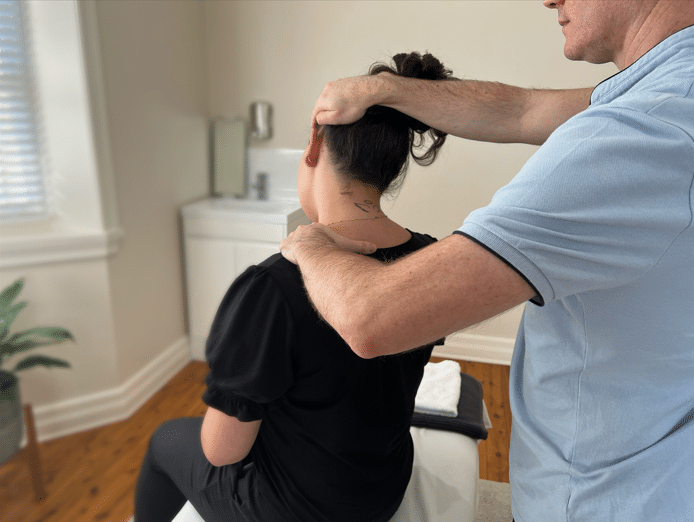
In practice, this is why a clinician might gently position your arm, then tilt your head to one side. We are checking whether nerve movement changes your symptoms. A small 2022 trial of 40 people tested this idea. Adding radial nerve gliding exercises to standard rehab reduced pain more at six weeks. Grip strength and function did not differ clearly between groups (Yilmaz et al., Journal of Hand Therapy). So nerve gliding is a promising option for some people, not a cure for everyone.
Strength and movement: what exercise does for a sensitive elbow
When something hurts, using it can feel wrong. That instinct is understandable. Yet carefully chosen exercise is one of the best supported options for tennis elbow.
A 2021 review of 30 trials with 2,123 people found exercise worked better than passive treatments. It also beat steroid injections for pain-free grip strength over time. The overall effects were small, and the evidence certainty was low (Karanasios et al., British Journal of Sports Medicine).
The dose matters too. A large 2023 meta-analysis across tendon problems found programs that added external load, like dumbbells or bands, tended to work better. Programs done less than daily, with rest days, also tended to do better than daily ones (Pavlova et al., British Journal of Sports Medicine).
Think of getting into the ocean at Bondi on a cool morning. You go in step by step, and your body adjusts. Exercise works in a similar way. Experts agree that some discomfort during exercise is fine, as long as it stays at a level you find acceptable (Bateman et al., BMJ Open).
How a multimodal chiropractic approach supports movement and strength
Your forearm may feel tight and ropey, and you might grip things carefully without thinking. We call this the stress response. It is your body’s natural protection when your nervous system senses a threat: muscles tighten, movement becomes guarded, and pain rises. Think of a security guard who will not stand down after the danger has passed.
At FDOC, we rarely treat persistent tennis elbow with one tool. Coombes and colleagues argue that one size does not fit all. They suggest checking the neck, upper back and radial nerve, then matching treatment to what drives your pain (Coombes et al., Journal of Orthopaedic & Sports Physical Therapy). Your plan may combine soft tissue therapy, joint and spinal adjustments, and a tailored exercise program. Each part has a different job.
The best evidence supports this as a combination, with exercise at the centre. A major clinical guideline recommends wrist strengthening alongside manual therapy. It suggests neck and upper back manipulation or mobilisation as an add-on for short-term relief, when problems there are found. It also supports elbow mobilisation for short-term pain relief and grip (Lucado et al., Journal of Orthopaedic & Sports Physical Therapy). Evidence for soft tissue release is more limited, coming from two low-quality studies.
It is important to be honest here. One expert panel left manual therapy out of its core program, partly because of the cost and time of extra visits (Bateman et al., BMJ Open). There is also no direct evidence that hands-on care switches off the stress response. The more accurate claim is this. Hands-on care can create a window of easier, less guarded movement. You then use that window to practise exercise, which builds lasting strength and confidence.
A chiropractor can also help you find the right exercise dose. That might mean fewer reps, lighter loads, or longer rests at first. A guideline example is three sets of 15 repetitions over six to 12 weeks, progressing without flaring symptoms (Lucado et al., Journal of Orthopaedic & Sports Physical Therapy). The right dose challenges your elbow without setting off the alarm.