What Your Nervous System and Physiotherapy
Let’s start simple. Your nervous system is your body’s communication network. It includes your brain, spinal cord, and nerves. Together, they sense, send, and interpret signals from every part of you. Think of it like a phone network running through your whole body. Wires carry messages, and a control centre decides how to respond. When you stub your toe, nerves send a message up to your brain. Your brain decides how much that message should hurt. This matters more than people realise, and I will explain why shortly. Your brain is not just a passive receiver of pain signals. It actively interprets, amplifies, or quietens them based on many factors.
Physiotherapy, in turn, is a well-established healthcare profession. Physios use exercise, manual techniques, and education to restore movement and function. It is genuinely evidence-based, and many people recover fully through physio care. So if your pain remains after physio, something else is often going on. That something is usually how your nervous system is processing pain itself. It is rarely about effort, compliance, or doing your exercises wrong.
Why Your Pain Signals Can Get Stuck Switched On
Here is where the science gets interesting. A 2025 review looked closely at this exact issue (Opara et al., 2025). It explained a process called central sensitization. In simple terms, your central nervous system can become overly reactive. Nerve cells in your spinal cord and brain start firing too easily. This means normal movements can trigger real pain. It is not imagined, and it is not exaggerated. Your nervous system has genuinely turned up its alarm volume. Imagine a smoke alarm so sensitive it triggers from steam in the shower. The threat is not real, but the alarm still goes off loudly.
This is surprisingly common in long-term low back pain. One study found signs of this in 43.6% of chronic low back pain patients (Opara et al., 2025). That is a large number of people. It also explains a tricky pattern many of my patients describe. Their pain spreads beyond where the original injury occurred. Light touch or pressure can feel far more painful than expected. This is allodynia, and it is a hallmark sign of a sensitised nervous system. People with this pattern often feel pain from things that should not hurt.
Here is the part that explains your experience exactly. The same 2025 review made an important point about treatment. Therapy that only targets the local painful area often falls short. This happens when central sensitization is part of the picture. It is not a flaw in physiotherapy as a profession. Many physios already use nervous-system-focused approaches, which I will cover soon. The issue is when treatment stays narrowly focused on tissue alone. The nervous system needs its own dedicated attention too.
How Your Tight, Achy Back Connects to Your Nervous System
You may be wondering why your back feels so tight. Your nervous system has a direct hand in this too. When pain-sensing neurons fire too much, they do not work alone. They also send signals to muscles around your spine (Opara et al., 2025). This can cause muscles to switch off properly working. Over time, this creates poor blood flow to the area. Poor blood flow leads to that dull, achy pain you know well. It also explains stubborn tightness that will not release with stretching alone. Many people stretch and stretch, yet the tightness simply returns.
This is genuinely useful to understand for one big reason. It is not about weak muscles or poor posture alone. Your nervous system can keep your muscles in a guarded state. This is sometimes called the body’s protective response. It happens even when there is no ongoing tissue damage. Think of it like a security guard who never stands down. Even after the danger has passed, the guard stays braced and tense. Knowing this can change how your treatment needs to be shaped.
Why Your Body Loses Track of Its Own Movement
Let me introduce a concept called proprioception. It is your nervous system’s sense of where your body is. You know your back is bending without needing to look. That is proprioception quietly working behind the scenes. It is like an internal map your brain checks constantly. In chronic low back pain, this map can become unreliable or out of date.
A detailed 2025 trial looked at this directly (Nyirö et al., 2025). Researchers compared spinal manipulation to gentle mobilisation and no treatment. After just one session, spinal manipulation shifted this sense back toward the spine. It also reduced pain more than the other two options. Importantly, this effect depended on each person’s starting point. People who already relied more on spinal input responded best. The exact link between this shift and pain relief remains genuinely unclear. The researchers found both effects without fully proving one causes the other. This is an honest gap that future research still needs to close.
How Movement and Strength Training Help Calm an Overprotective Nervous System
This is where movement becomes part of the answer, not the enemy. A large 2025 meta-analysis looked at pain neuroscience education (Medina-Viedma et al., 2025). This approach teaches you how pain actually works in your body. It pulled together 15 trials and over 800 patients with chronic low back pain. The results were genuinely encouraging across the board. Pain intensity, disability, and fear of movement all improved significantly. These improvements held steady at one and three months later. That staying power matters, since many treatments fade quickly after stopping.
Fear of movement deserves special mention here, since it traps many people. When your nervous system is sensitised, movement can feel threatening. This fear often leads to avoiding exercise altogether. Unfortunately, avoiding movement can make muscles weaker over time. Weaker muscles and joints can then raise your risk of new injuries. This creates a frustrating cycle of pain, fear, and further deconditioning. Graded strength training, introduced carefully, helps break this exact cycle. Building strength slowly shows your nervous system that movement is safe again. Small, steady wins matter more here than big, sudden pushes.
A Multimodal Chiropractic Approach to Calming Your Nervous System
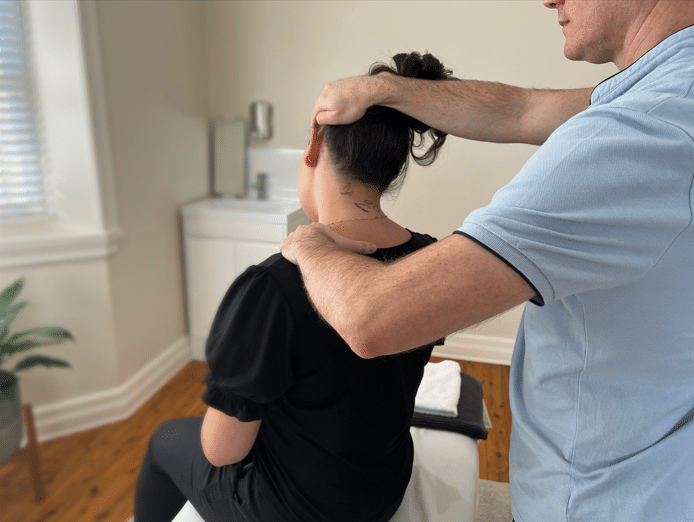
This brings me to how I approach care in my own clinic. A detailed 2021 review looked closely at chiropractic spinal manipulation (Gevers-Montoro et al., 2021). It compared manipulation alone, exercise alone, and the two combined. The strongest evidence supported combining hands-on care with the right exercise. This multimodal approach includes soft tissue therapy and spinal adjustments. It also includes exercise prescribed at a dose that suits you.
This dosing piece genuinely matters more than most people realise. Too much exercise, too soon, can reinforce your nervous system’s alarm. Too little exercise will not retrain it at all. There is a narrow window where movement helps without overwhelming you. As your chiropractor, I look at your pain, your fear of movement, and your strength. From there, I build a plan that gradually rebuilds your confidence to move. I also use hands-on techniques to ease tight, guarded muscles directly. The goal is never to bypass other care you have received. It is to add the nervous system piece that may have been missing.
One honest note before we finish. Not every case of ongoing back pain involves central sensitization. Some pain needs further investigation to rule out other causes. Conditions like fractures, nerve compression, or inflammatory disease need ruling out first. A good clinician should always check for this before anything else. If your pain persists despite good treatment, this is worth exploring together. Bring up your full history, including past injuries and stress levels. The more your clinician knows, the better your plan can be.