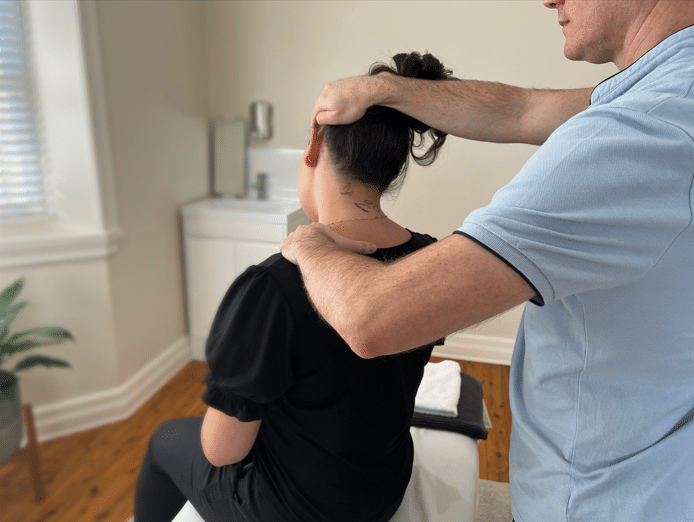
Why low mood and muscle tightness turn up together each winter
“Winter blues” is the everyday name for a mild seasonal dip in mood. It sits below the threshold for a formal diagnosis. Mostly you just feel flat, tired, and heavier than usual.
You might assume Australia is spared this. We are not, entirely. A 2023 review of the Australian research found that seasonality here was linked to changes in mood and behaviour. Rates were highest in the far south of the country. Sydney sits a long way north of Hobart, so our seasonal swing is smaller. Smaller is not the same as zero.
Light seems to be part of the story. One study measured light exposure on the wrists of almost 87,000 adults. More daytime light was linked to lower odds of major depression. That study was a snapshot in time, so it cannot prove light caused the difference. People who feel well may simply go outside more. But it does match what we see. The people who stop walking at lunchtime in June often notice it by August.
How moving less becomes dull, achy pain
Winter genuinely changes what your body does all day. A systematic review of 26 studies across 18 countries found physical activity drops in winter and rises in summer. A separate Australian-led review found sedentary time was highest in winter, and light activity highest in summer.
Notice that the biggest shift is in light activity. Not the gym. It is the incidental stuff — walking to the shops, standing on the platform, taking the long way round. That is the movement quietly disappearing from your day.
Your body notices. Tissues that move less often feel stiffer and achier. Here is where it gets interesting, though. An Australian research team tested whether people who feel stiff in the back actually are stiff. They measured it directly across three experiments. The feeling of stiffness had no real relationship to measured spinal stiffness. Instead, people who felt stiff were more sensitive to force applied to their spine. The researchers suggested stiffness may be a protective signal, not a mechanical fact.
That matters for you. If tightness is partly a protection setting, then only stretching it may miss the point. Giving your nervous system evidence that movement is safe often does more. That is why we may ask you to load a “tight” area rather than just release it.
What the evidence says about movement, strength and low mood
This is the part with the strongest evidence, so it deserves the most attention.
A 2022 review pooled 15 studies and over 191,000 adults. Compared with doing nothing, adults doing half the recommended activity had 18% lower risk of depression. Adults hitting the full recommendation had 25% lower risk. Beyond that, the extra benefit shrank.
Read those numbers again. Most of the benefit arrives early. Going from nothing to something buys you far more than going from lots to more. If winter has flattened you, that is genuinely good news. You do not need a heroic plan.
For people already experiencing depression, a 2024 BMJ review pooled 218 trials and 14,170 participants. Walking or jogging, yoga, strength training and tai chi all reduced depression compared with usual care. Effects were larger when the exercise was more intense. Strength training and yoga had the lowest dropout rates.
The authors were also refreshingly honest. Only one of those 218 studies met the strictest standard for low risk of bias. You cannot blind someone to whether they went for a run. So their confidence in the findings was rated low. The direction of the evidence is consistent and encouraging. The precision is not.
What this means for you is simple. The type matters less than whether you keep doing it. Pick the one you will still be doing in September.
Where body work and hands-on care fit in
Let us be clear about what manual therapy can and cannot claim here.
A 2024 systematic review looked at manual therapy and anxiety. It included 34 studies covering massage, osteopathic treatment, reflexology and gentle touch. Twenty-seven showed a statistically significant benefit for anxiety. The reviewers graded the strength of that recommendation as “B”. In plain terms: consistent, promising, but not built on high-quality trials.
Now the harder finding. Spinal adjustments are often said to calm your stress response directly. A 2024 review and meta-analysis pooled 14 trials and 618 participants. It measured heart rate variability, blood pressure and stress hormones. Compared with sham treatment, spinal manipulation did not shift these markers. Neck manipulation showed a possible effect on one measure, on low-quality evidence.
We would rather tell you that than sell you something. An adjustment is not a reset button for your nervous system. What hands-on care does reliably do is reduce pain and improve how you move in the short term. When you hurt less, you move more. Movement is the part carrying the mental health evidence.
The evidence for a multimodal chiropractic approach
So does combining soft tissue therapy, adjustments and exercise beat doing one alone?
For pain and function, largely yes. A 2025 systematic review examined adding manual therapy to exercise for chronic low back pain. Manual therapy plus exercise improved short-term pain, function and disability more than exercise alone.
But read the detail. Of the three trials testing spinal manipulation specifically, two found it added nothing to exercise. The gains came mostly from soft tissue work and mobilisation, not from adjusting. The benefits were also short-term.
So here is our honest position. The multimodal case rests on manual therapy making movement more tolerable so that exercise can do its work. We could not find evidence that this combination directly regulates your stress response. Although is not currently supported by high quality research, the research is evolving and it is exciting to see what the research will reveal.
How a chiropractor can help you find the right exercise dose
Dosage is where an assessment earns its keep. Too little and nothing changes. Too much and you flare, stop, and conclude exercise is not for you.
We start by working out what your body tolerates today, not what it should tolerate. We test how you load, bend, balance and push your body. We may ask you to stand on one leg with your eyes closed. That removes vision and forces your body to rely on proprioception, its own internal sense of position. If proprioception is poor, we start with control before we add intensity.
We then set a dose you can actually repeat. Most of the mood benefit arrives at low volumes. So we would rather you walk fifteen minutes daily than plan an hour and skip it. Intensity does help, so we build that gradually once the habit holds. In winter, we will also nudge you to do it in daylight rather than after dark.
To be straight with you: no trial has tested whether chiropractor-guided dosing beats generic advice for low mood. That is a reasonable inference from the dose-response research, not a proven finding. What we can say is this. People in pain often need help getting moving and calibrating how much exercise to do. Calibrating load is exactly what we are trained to do.