The three types we see most
Tension-type headache
This is the most common headache of all.
Most people feel it on both sides of the head. It’s a dull, pressing or tightening feeling, a bit like a band around the head. It doesn’t usually throb. It’s mild to moderate, and it doesn’t tend to get worse when you walk up a flight of stairs.
We don’t fully understand what drives it. The current thinking points to two things working together. One is tenderness in the muscles of the head and neck. The other, in people who get frequent headaches, is a change in how the nervous system processes pain signals.
Migraine
Migraine is not “a bad tension headache.” It’s a distinct neurological condition.
Attacks are often on one side. The pain throbs, sits at moderate to severe, and gets worse with movement. Nausea is common. So is sensitivity to light and sound. Some people get an aura first, which means visual or sensory changes before the pain starts.
Migraine involves the brain and its pain and sensory pathways. That’s why management sits mostly in the medical and lifestyle space. It isn’t a mechanical problem we can simply unlock.
That said, plenty of people with migraine also carry neck pain. Many have an overlapping tension-type or cervicogenic headache as well. Sorting out those contributors is a fair part of the wider picture. It just isn’t treating the migraine itself, and we’re careful not to pretend otherwise.
Cervicogenic headache
This one is a secondary headache. The pain is referred to the head from structures in the upper neck.
It’s usually on one side, and it tends to stay on that side. Neck movements or long-held postures can often bring it on, or reproduce it in the clinic.
It is genuinely tricky to diagnose. Its features overlap with both tension-type headache and migraine. A proper diagnosis rests on showing that the neck is the source, not assuming it.
How to tell them apart
Here’s the short version:
- Tension-type: both sides, pressing or tightening, no nausea, no throbbing, not worse with activity.
- Migraine: often one side, throbbing, worse with movement, with nausea and light or sound sensitivity, sometimes with aura beforehand.
- Cervicogenic: one side and staying there, linked to the neck, often reproducible with neck movement.
These patterns guide our thinking. But no single feature settles it on its own.
People can also have more than one type at once. Migraine and tension-type headache often travel together. Neck involvement can sit alongside either of them.
When a headache needs urgent care
Some headaches are not a wait-and-see situation. Please seek urgent medical care for:
- A sudden, severe “worst headache of your life” that peaks within seconds to minutes
- A new headache, or one that feels clearly different, especially if you’re over 50
- A headache with fever, neck stiffness, a rash, or feeling very unwell
- A headache with new neurological symptoms, such as weakness, numbness, trouble speaking, vision loss or confusion
- A headache that steadily worsens over days to weeks, or one triggered by coughing, straining or exertion
These can point to a serious underlying cause. They need prompt medical assessment, not conservative care.
How each type is managed
Three different problems means three different plans. Being honest about what helps which one matters.
Tension-type headache
Management centres on reassurance, understanding your triggers, and staying active. Common triggers include stress, poor sleep and long-held postures.
Simple pain relief has a role for the occasional episode. It isn’t a strategy for frequent headaches.
Physical approaches are widely used here. That includes manual therapy, exercise and general activity. They can help some people, though the overall evidence for them is modest. For frequent tension-type headache, a combination of strategies usually works better than any single one.
Migraine
Migraine is managed primarily as a medical condition. That means acute medication for attacks. Where attacks are frequent, it also means preventive strategies, ideally guided by a GP or neurologist.
Lifestyle factors genuinely matter. Regular sleep, hydration, regular meals and stress management all count. So does regular aerobic exercise, which has reasonable evidence behind it as part of prevention.
Manual therapy is not a treatment for migraine itself. Where neck symptoms coexist, treating them may improve your overall picture. We won’t frame that as treating the migraine, because it isn’t.
Cervicogenic headache
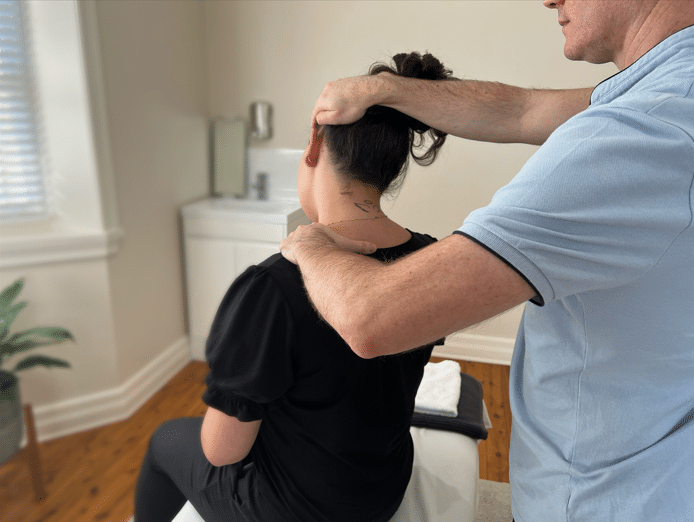
This is the type where hands-on and exercise-based care has the clearest rationale. The source is the neck, so the neck is where we work.
Current evidence suggests manual therapy can give short-term relief of headache intensity. The longer-term picture is less certain, as is the added value of combining approaches. Exercise for the neck and its supporting muscles is a reasonable part of the plan.
In short: helpful for many people in the short term, not a guaranteed or permanent fix, and best delivered as part of a considered plan.
The most valuable step
Across all three types, the single most useful thing is working out which headache you’re actually dealing with.
A migraine managed as a tension headache leads somewhere different. A serious secondary headache mistaken for either leads somewhere different again.
That’s the case for a proper assessment rather than a one-size-fits-all fix. Our job is to work out whether your neck is part of the story, treat it where it is, and point you in the right direction where it isn’t.