- 02 9712 1736
- [email protected]
- 212 Great North Road, Five Dock, NSW 2046
- Open 7 days a week
Your body is designed to move in seven fundamental patterns every single day. Whether you’re picking up groceries, climbing stairs, or playing with your kids, these movements form the foundation of everything you do. As an osteopath, I’ve seen how mastering these seven movement patterns can transform your pain and prevent future injuries. When you move well, you feel well. When your movement patterns break down, that’s often when your pain begins.
Understanding these seven movements isn’t just for athletes or fitness enthusiasts. It’s for anyone who wants to move through life with confidence, strength, and freedom from pain. In this guide, I’ll show you exactly what these movements are, why they matter for your health, and how working with an osteopath can help you master them safely.
Your body performs seven fundamental movements: squatting, hip hinging, lunging, pushing, pulling, rotating, and walking/running. Research from 2024 indicates that poor movement patterns increase your risk of injury by nearly six times. When you improve these basic movements, you reduce pain, prevent injuries, and move with greater ease and efficiency. A chiropractor can assess your movement patterns, identify where your body compensates, and create a safe plan to restore optimal function.
These seven fundamental movements are hardwired into your DNA and critical for daily life activities. Recent research reveals just how important quality movement is for your health. A 2024 study following 123 physically active adults for six months found that people with poor movement quality had nearly six times higher injury risk.
Modern technology now allows us to analyse movement patterns and identify risk factors before injuries occur. As your chiropractor, I use these insights to assess how you move and where your body might be setting you up for problems down the road.
Your movement patterns tell a story. They reveal old injuries, daily habits, and areas where your body has learned to compensate. When we improve these patterns together, we’re not just treating your current pain – we’re preventing future problems.
Before we dive into the seven movements, let me explain how I approach movement assessment in my practice. Research shows that movement pattern quality is an accurate predictor of injury risk, which is why proper assessment is crucial.
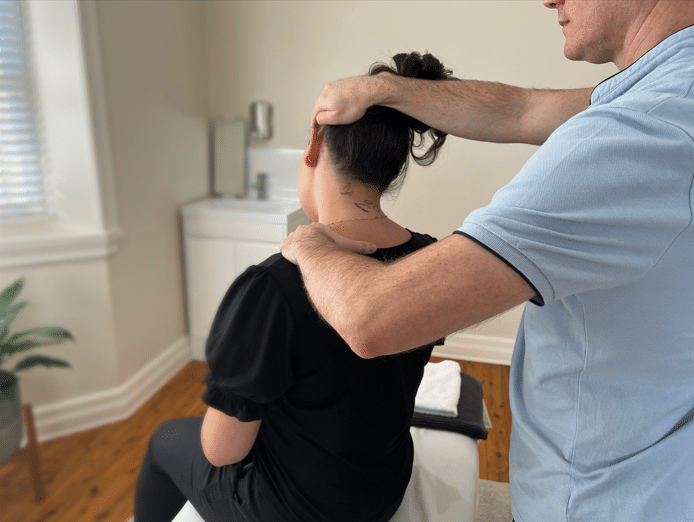
During your visit, I will watch how you perform basic movements. I’m looking for asymmetries, compensations, and areas where your body might be working harder than it needs to. This isn’t about perfect form – it’s about finding movement patterns that work for your unique body and lifestyle.
The chiropractc approach recognises that everything in your body is connected. Your tight hip might actually be protecting a restriction in your spine. Your shoulder pain could stem from how you breathe. By understanding these connections, we can address the root cause of your movement problems, not just the symptoms.
The squat is perhaps the most important movement you’ll ever master. Every time you sit down or stand up, you’re squatting. The squat is considered the most complex movement the human body is capable of, involving your ankles, knees, hips, and spine working together.
Why it matters for your health: When you can squat well, you take pressure off your knees and lower back. Poor squatting mechanics force these areas to work harder, often leading to pain over time.
Common problems I see: Many people push their knees forward instead of sitting back with their hips. This puts excessive stress on your knee joints and can lead to pain.
How your chiropractor can help: I’ll assess your ankle mobility, hip flexibility, and spine alignment to identify what’s limiting your squat. Often, improving movement in one area dramatically improves your entire squat pattern.
The hip hinge is a hip-dominant movement crucial for posterior chain strength. This is the movement you use when bending over to pick something up or deadlifting at the gym.
Why it matters for your health: Proper hip hinging protects your lower back by using your powerful hip muscles instead of your spine to create movement. This is essential for preventing back injuries.
Common problems I see: Many people bend from their back instead of their hips when picking things up. This puts enormous stress on your spine and is a recipe for injury.
How your chiropractor can help: I’ll teach you to feel the difference between hip movement and spine movement. Often, tight hip flexors or weak glutes prevent proper hip hinging, and we can address these issues with hands-on treatment and specific exercises.
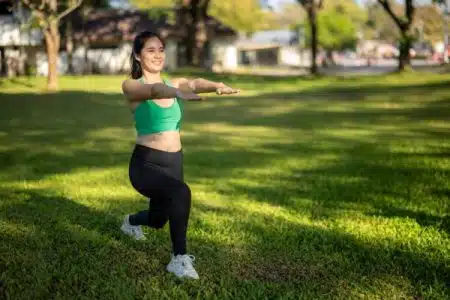
Lunge exercises enhance strength, stability, and functional fitness. Every time you walk upstairs, step over something, or get up from the floor, you’re using a lunge pattern.
Why it matters for your health: Lunges reveal imbalances between your left and right sides. They also challenge your balance and coordination, which are crucial for preventing falls as you age.
Common problems I see: One leg often works much harder than the other. You might notice this when you feel more stable lunging with your right leg forward versus your left.
How your chiropractor can help: I’ll identify which side is weaker or less mobile and create a plan to balance things out. Sometimes, a simple osteopathic technique to improve pelvic alignment can immediately improve your lunge quality.
Push movements involve pushing away from the body or pushing your body away from an object. Think push-ups, or pushing a heavy door open.
Why it matters for your health: Strong pushing movements protect your shoulders and improve your posture. They counteract the forward head posture many of us develop from desk work.
Common problems I see: Weak pushing strength often comes from poor shoulder blade mobility or core instability. You might feel this as shoulder pain or neck tension.
How your chiropractor can help: I’ll assess your shoulder blade movement and rib cage mobility. Often, improving how your ribs move with breathing dramatically improves your pushing strength and reduces shoulder pain.
Pull movements involve bringing weight toward your body or pulling your body toward your hands. Examples include pull-ups, rowing motions, or pulling open a heavy door.
Why it matters for your health: Balancing push and pull movements is key to preventing muscular imbalances and subsequent injuries. Strong pulling muscles improve your posture and reduce neck and shoulder pain.
Common problems I see: Most people are much stronger at pushing than pulling, leading to rounded shoulders and forward head posture.
How your chiropractor can help: I’ll work on your upper spine mobility and teach you how to engage your pulling muscles properly. Sometimes addressing tension in your chest muscles immediately improves your pulling strength.
Rotation governs your body’s ability to produce rotational forces and is crucial in most sports. You rotate when you swing a tennis racket, throw a ball, or simply turn to look behind you.
Why it matters for your health: Good rotation comes from your thoracic spine (mid-back), not your lower back. When your mid-back doesn’t rotate well, your lower back tries to compensate, often leading to pain.
Common problems I see: Limited rotation in the thoracic spine, often from prolonged sitting and poor posture.
How your chiropractor can help: I’ll assess and improve your spinal rotation using gentle osteopathic techniques. Often, working on your rib cage mobility dramatically improves your ability to rotate safely.
Walking and running are vital for overall mobility. Gait encompasses all forms of locomotion, from casual walking to running.
Why it matters for your health: Poor walking patterns can create problems throughout your body. Your gait affects your knees, hips, back, and even your neck and shoulders.
Common problems I see: Asymmetrical walking patterns, often due to old injuries or imbalances. You might notice one foot wears out shoes faster than the other.
How your chiropractor can help: I’ll analyse your walking pattern and identify areas of restriction or weakness. Sometimes, addressing an old ankle injury dramatically improves your entire gait pattern.
Research consistently shows that poor movement patterns increase injury risk and can predict future problems. In my practice, I’ve found that addressing movement quality often provides faster, longer-lasting relief than treating symptoms alone.
When you understand how to move well, you become an active participant in your recovery. You’re not just receiving treatment – you’re learning skills that will serve you for life. This aligns with the osteopathic philosophy of facilitating your body’s natural ability to heal.
Modern research shows that movement analysis can identify inefficiencies and risk patterns before they become injuries. This is why I assess these patterns during your visits – we’re not just treating your current pain, we’re preventing future problems.
My approach combines the latest research with time-tested chiropractic principles. Recent studies show that chiropractic manual therapy effectively improves movement patterns and reduces pain.
Here’s how we work together:
Assessment: I watch you move and identify patterns that might be contributing to your pain. This isn’t about judging your technique – it’s about understanding your unique movement signature.
Hands-on Treatment: Using gentle chiropractic techniques, I address restrictions in your joints, muscles, and connective tissues that limit your movement quality.
Education: I teach you how to feel good movement versus compensatory patterns. Understanding the difference empowers you to make better choices throughout your day.
Progressive Loading: We gradually challenge your movement patterns with exercises that are appropriate for your current abilities and goals.
Integration: We work on incorporating these improved patterns into your daily activities, not just isolated exercises.
Evidence shows the need for multidimensional, multimodal approaches in treating musculoskeletal pain. This is exactly what chiropractic care provides. I don’t just give you exercises – I help your body remember how to move the way it was designed to.
Every person I treat has a unique movement signature shaped by their history, habits, and goals. Your movement training should reflect this individuality. The chiropractic approach recognises that mechanically, everything is connected in your body, from head to toe.
Safety first: Before progressing any movement, I ensure your body has the mobility and stability to perform it safely. Rushing into complex movements without proper preparation often leads to injury.
Addressing root causes: Sometimes, a tight muscle is protecting a deeper problem elsewhere in your body. By addressing these underlying issues with chiropractic treatment, movement often improves naturally.
Sustainable progress: My goal isn’t to create dependency but to give you tools for lifelong movement health. When you understand your body better, you can maintain and continue improving your movement patterns independently.
Scott has more than 20 years of clinical experience as a movement expert and musculoskeletal health professional. His thorough understanding of how pain affects your spine, joints, muscles, and total well-being is the result of significant academic study and many many years of clinical experience. Scott’s real interest in movement mechanics enables him to develop individualised care plans that summarise complex problems into clear, simple treatments, leading to quicker healing times. His friendly, attentive approach ensures that you not only comprehend but also feel supported throughout your treatment journey, allowing you to return to the things you like with restored confidence and vitality.
Forest Lodge, Annandale, Glebe, Leichhardt, Balmain, Haberfield, Canada Bay, Rozelle, Rodd Point, Wareemba, Stanmore, Petersham, Lilyfield, Hunters Hill, Enfield, Cabarita, Mortlake, Rhodes, Burwood Heights, Birchgrove, Gladesville, Huntleys Point, Abbotsford, Ashfield, Croydon Park, Croydon, Chiswick, Russell Lea, Burwood, Strathfield, Concord, Drummoyne, North Strathfield, Liberty Grove, Dulwich Hill, Lewisham, Camperdown, Ashbury, Homebush, Homebush West, Woolwich, Henley, Summer Hill, Sydney Olympic Park