Your Body’s Balance System
Your ability to stay balanced and oriented depends on three key sensory systems working together:
- The Vestibular System (Inner Ear)
- Acts as your internal gyroscope
- Detects gravity and head movement
- Answers two fundamental questions: “Which way is up?” and “Where am I?”
- Eyes (Vision)
- Provides visual references for orientation
- Helps stabilize your gaze during movement
- Neck Proprioception (Position Sense)
- Your neck contains the highest density of specialized sensory receptors (muscle spindles) anywhere in the body
- These receptors constantly inform your brain about head position relative to your body
- They have direct connections to your balance centres and eye movement control systems
When these three systems provide conflicting information to your brain, dizziness and imbalance can result.
The Neurology of Your Cervical Spine
Your cervical spine (neck) is far more than just a support structure for your head. The deep muscles at the base of your skull—the suboccipital muscles—contain up to 200 muscle spindles per gram of muscle. Compare this to your hand, which has only 16 per gram!
When the cervical spine is not moving properly, we can experience:
- Altered Proprioceptive Input
- Your brain receives faulty information about head position, creating a mismatch with vestibular and visual input.
- Disrupted Eye Movement Control
- Research shows that people with neck pain often have:
- Difficulty with smooth pursuit eye movements
- Altered gaze stability
- Problems coordinating head and eye movements
- Postural Instability
- Abnormal neck sensory input can lead to:
- Increased body sway
- Difficulty maintaining balance, especially with eyes closed
- The Vicious Cycle
- Poor neck function → Altered sensory input → Dizziness and balance problems → Protective muscle guarding → Further neck dysfunction
The Common Causes of Dizziness
Benign Paroxysmal Positional Vertigo (BPPV)
BPPV is one of the most common causes of vertigo—that spinning sensation that can be triggered by changes in head position. It occurs when tiny calcium crystals in your inner ear become dislodged and move into the wrong part of your vestibular system.
Symptoms of BPPV:
- Brief episodes of spinning sensation with head movements
- Triggered by rolling over in bed, looking up, or bending down
- Often accompanied by nausea
- Episodes typically last less than a minute
Treatment for BPPV
The good news, BPPV is highly treatable with specific repositioning manoeuvres can often resolve symptoms quickly.
Cervicogenic Dizziness
This type of dizziness originates from neck dysfunction and is characterized by:
- Dizziness associated with neck pain or stiffness
- Unsteadiness that worsens with neck movements
- Often follows whiplash injury or develops with chronic neck problems
- May include visual disturbances or difficulty with reading
Nystagmus
Nystagmus is an involuntary, rhythmic beating movement of the eyes that can indicate problems with your balance system. Think of it as your eyes’ way of revealing an imbalance in your vestibular pathways.
Key characteristics:
- Nystagmus has both a slow drift phase and a fast corrective phase
- Can be caused by vestibular problems, neck dysfunction, or neurological issues
- Not always a sign of serious pathology—can occur in benign conditions like BPPV
The Chiropractic Approach to Dizziness and Balance
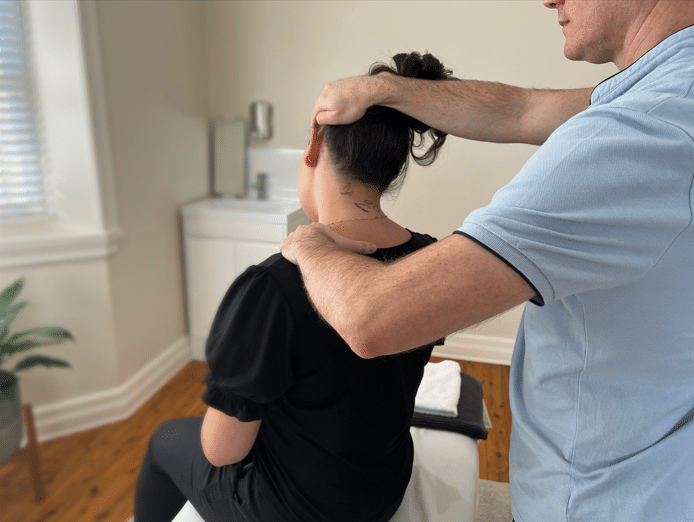
Chiropractic treatment for dizziness and balance begins with a thorough evaluation comprehensive history taking a full neurological examination to help identify the root cause.
A specific diagnosis is essential. Different causes of dizziness require different treatments. We ensure we’re treating the right problem while keeping you safe.
Evidence-Based Treatment
Research demonstrates that addressing cervical dysfunction can improve:
- Cervical joint position sense
- Balance and postural stability
- Eye movement control
- Overall dizziness symptoms
- Quality of life and daily function
Studies show that combining spinal adjustments with specific sensorimotor retraining exercises provides better outcomes than either approach alone.
Treatment for BPPV
BPPV responds remarkably well to specific treatment manoeuvres that physically move the displaced calcium crystals back to their proper location.
The Epley Manoeuvre
- One of the many types of manoeuvres and most commonly used for treatment.
- A carefully sequenced series of head positions held for 30-60 seconds each
- Guides the loose crystals through the semicircular canal and back into the utricle
- Success rate: 80-90% with proper technique
- Many patients experience immediate or same-day relief
What to Expect During Treatment:
- The manoeuvre may temporarily reproduce your vertigo symptoms
- This is normal and indicates the movement of the crystals
- Symptoms typically resolve within minutes of completing the procedure
- You may feel slightly off-balance for 24-48 hours as your brain readjusts
- Post-manoeuvre restrictions are minimal with modern techniques
Red Flags: When to Seek Immediate Medical Attention
While most dizziness is not serious, seek immediate medical care if you experience:
- Sudden, severe dizziness with headache
- Dizziness with double vision, slurred speech, or weakness
- Dizziness with chest pain or difficulty breathing
- Loss of consciousness
- Severe, persistent vertigo lasting hours or days
- New onset dizziness after head trauma