- 02 9712 1736
- [email protected]
- 212 Great North Road, Five Dock, NSW 2046
- Open 7 days a week

Feeling drained is not always about sleep or motivation. When your body is stiff, tense, or moving poorly, everyday tasks take more effort than they should. That “working harder” feeling adds up over time. If you sit for long stretches, carry stress in your shoulders, or notice frequent tightness, your spine might be part of the problem. In this blog, I want to explain how your spinal health connects to your energy levels. As a chiropractor, I see this pattern in my clinic every single day. And the good news? There are real, evidence-based ways to help you feel lighter and more energised.

Let me start with a simple idea. Your spine is designed to move. It has over twenty individual segments. Each one should glide, bend, and rotate smoothly. When these segments get stiff, your body has to work harder.
Think of it like riding a bicycle with a rusty chain. The bike still moves. But you have to pedal much harder to go the same distance. Your body does the same thing when your spine is stiff. Every movement costs more energy than it should.
Research confirms this connection. Prolonged sitting leads to a slumped posture. This indirectly increases spinal stiffness and hamstring tightness (Amiri & Zemková, 2024). When your spine stiffens, the muscles around it have to work overtime. They stay switched on longer than they need to. This constant low-level effort drains your energy throughout the day.
You might not even notice it happening. But by mid-afternoon, you feel exhausted. Not from hard physical work. Just from your body compensating for poor spinal movement.
Here is something that might surprise you. Sitting is one of the biggest contributors to spinal stiffness. And most of us sit for hours every day.
When you sit for long periods, your deep trunk muscles fatigue. These are the muscles that support your spine from the inside. Research shows that prolonged sitting causes ongoing contraction of trunk muscles. This leads to fatigue in your deep stabilising muscles (Amiri & Zemková, 2024). When these muscles tire out, your body shifts the workload elsewhere.
Your spine then relies more on passive structures. These include your ligaments, discs, and joint capsules. These structures were not designed to bear that load continuously. Over time, they stiffen. Your body responds by tightening surrounding muscles to compensate. This compensation pattern uses more energy than normal movement would.
A scoping review published in 2025 confirmed this pattern. Prolonged sitting induces fatigue in deep trunk muscles. This decreases spinal support and increases stress on the spine (Saiklang et al., 2025). The result is a cycle of stiffness, compensation, and fatigue.
Think of it like a team project at work. When one person stops doing their job, everyone else has to pick up the slack. Your body works the same way. When your deep spinal muscles fatigue, other muscles compensate. That compensation costs you energy.
Your spine does more than just hold you upright. It houses your spinal cord. Your spinal cord is the main highway between your brain and your body. Every nerve signal passes through or near your spine.
When your spinal joints are stiff, the sensory receptors around those joints send altered signals to your brain. Your brain constantly monitors these signals. It uses them to coordinate your posture and movement. When the signals are disrupted, your brain has to work harder to maintain control.
Research shows that muscle fatigue disrupts afferent feedback. This impairs joint proprioception and affects somatosensory input (Tajali et al., 2022). In simple terms, your brain receives less accurate information from stiff joints. It compensates by increasing muscle tension. This protective response uses more energy.
Think of your nervous system like a GPS navigation system. When the signal is clear, you drive efficiently. When the signal is poor, you take wrong turns and detours. Your body does the same thing. Poor sensory feedback from stiff joints forces your body into inefficient movement patterns.
Your brain also controls your autonomic nervous system through your spine. This is the system that manages your stress response. Research suggests that spinal manipulation may influence autonomic nervous system activity. It may help shift your body from a stress state toward a recovery state (Picchiottino et al., 2019). When your body is stuck in a stress response, it burns through energy faster.
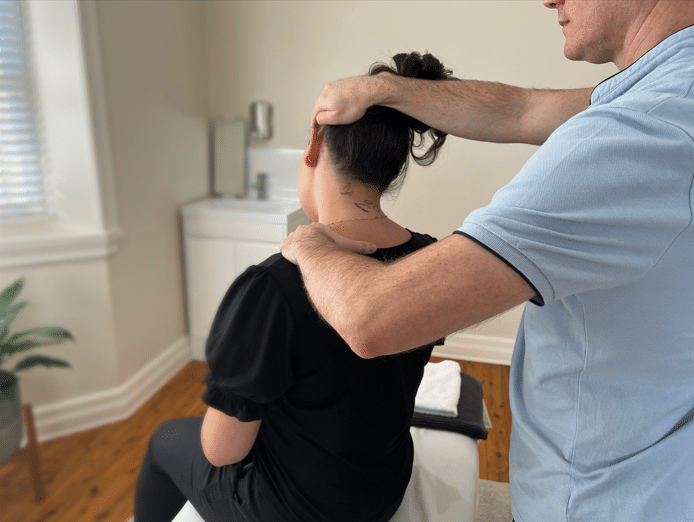
This is where I can help. As a chiropractor, I use a multimodal approach. This means I combine several evidence-based treatments tailored to your needs. These include soft tissue therapy, spinal adjustments, and prescribed exercise.
Soft tissue therapy helps release the tight muscles that have been compensating. When your muscles have been working overtime, they develop tension and restriction. Soft tissue work helps reduce this guarding. It improves blood flow and helps your muscles relax.
Spinal adjustments target the stiff joints directly. A large network meta-analysis including 161 randomised controlled trials found that spinal manipulative therapy was effective for reducing spinal pain (Nim et al., 2025). When your spinal joints move better, the muscles around them can relax. Your body no longer needs to compensate as much.
But here is the critical part. Treatment alone is not enough. You also need the right exercises. I prescribe specific exercises based on your presentation. Exercise dosage matters. Too little will not change your movement patterns. Too much can overwhelm already fatigued muscles. Finding the right balance is essential.
Research strongly supports combining manual therapy with exercise. The strongest evidence for managing spinal pain comes from multimodal approaches. Spinal manipulation combined with exercise may provide one of the best treatment strategies (Gevers-Montoro et al., 2021). This combination addresses the stiffness, the muscle compensation, and the nervous system component.
Core stabilisation exercises are particularly important. A 2025 scoping review found that core exercise programs improved deep trunk muscle function after prolonged sitting. They increased muscle stiffness in a healthy way and improved neuromuscular control (Saiklang et al., 2025). This means your stabilising muscles work better. Your body compensates less. You use less energy for daily tasks.
I want you to understand why your spine affects so much. Your spinal joints contain tiny sensory receptors. These include Ruffini endings, Pacinian corpuscles, and Golgi-like organs. They constantly send information to your brain about joint position and movement.
Your brain uses this information to coordinate everything you do. It monitors how your spine is moving. It adjusts your muscle tension accordingly. This is a constant feedback loop between your spine and your brain. Your brain is constantly monitoring and responding to the sensory information from these receptors.
When your spinal joints are stiff, these receptors send different signals. They may fire more frequently or less accurately. Your brain interprets this as a problem. It responds by increasing protective muscle tension. This is your body’s way of guarding against potential injury.
The problem is that this protective response costs energy. Your muscles stay switched on when they should be resting. Your body stays in a low-level state of alert. Over time, this background tension drains your energy reserves.
Think of it like leaving all the lights on in your house. Each light uses a small amount of electricity. But when they are all on at once, your power bill goes up. Your body does the same thing. Background muscle tension from spinal stiffness slowly drains your energy.
When we improve your spinal movement, something interesting happens. Your muscles do not need to compensate as much. Your nervous system receives clearer signals. In turn, your brain can coordinate movement more efficiently.
Many of my patients notice this shift. They describe feeling lighter. Moving more freely. Having more energy at the end of the day. They recover better between busy days. This is not a placebo effect. It is the result of more efficient biomechanics.
When your spine moves well, your body uses less energy for basic tasks. Sitting requires less effort. Standing feels easier. Walking becomes more fluid. You free up energy that was previously being wasted on compensation. That freed-up energy is what makes you feel more alive.
For those who want a deeper understanding, the energy cost of spinal stiffness is well documented. Research shows that prolonged static trunk flexion increases the magnitude of decrements in trunk stiffness over time (Park & Srinivasan, 2021). This creates a paradox. The passive tissues stiffen, but the active stabilising system becomes less effective.
The result is that superficial muscles must increase their activity to compensate for reduced deep muscle function. Surface electromyography studies confirm that prolonged sitting significantly increases lower back muscle stiffness (Ellegaard et al., 2021). This increased activation of superficial muscles is metabolically expensive. It contributes to the subjective experience of fatigue.
From a neurophysiological perspective, a systematic review on spinal manual therapy found evidence of changes in both central nervous system activity and autonomic nervous system responses following treatment (Lascurain-Aguirrebeña et al., 2025). These short-term neurophysiological changes may help explain why patients report feeling more energised after chiropractic care.
One important pitfall is misattributing spinal-related fatigue to poor motivation or laziness. If your body is running inefficiently due to spinal stiffness, you will feel tired regardless of how motivated you are. This is a biomechanical and neurological problem. It is not a character flaw.
Many patients come to me frustrated with themselves. They think they should have more energy. They blame their sleep, their diet, or their mindset. These factors absolutely matter. But if your spine is stiff and your muscles are constantly compensating, you are fighting an uphill battle.
Addressing the spinal component often provides a noticeable shift. It does not replace good sleep or nutrition. But it removes a significant energy drain that many people do not know exists.
Another common mistake is relying solely on passive treatments like adjustments or massage. While these treatments are effective for reducing stiffness and pain sensitivity, they need to be paired with active rehabilitation.
Research consistently shows that the combination of spinal manipulation and exercise produces the strongest outcomes for spinal pain (Gevers-Montoro et al., 2021). Passive treatment provides the window of opportunity. Exercise locks in the changes. Without the exercise component, the stiffness and compensation patterns often return.
This is why I prescribe specific exercises for each patient. The goal is to retrain your deep stabilising muscles. To improve your proprioception. To teach your body more efficient movement patterns. The right exercise dosage, combined with hands-on treatment, creates lasting change.
Your autonomic nervous system plays a larger role in energy than most people realise. When your body is stuck in a sympathetic dominant state, it uses energy at a higher rate. You feel wired but tired. Alert but exhausted.
Research suggests that spinal mobilisation may influence autonomic nervous system markers, though the evidence remains mixed and requires further investigation (Picchiottino et al., 2019). What is clearer is that reducing pain and improving mobility helps shift your body away from a chronic stress response. When your nervous system feels safer, your body conserves energy more effectively.

Your spine directly influences how much energy your body uses every day. When spinal joints are stiff, your muscles compensate by working harder. Your nervous system receives disrupted sensory feedback. Your brain increases protective tension. All of this costs you energy without you realising it. Prolonged sitting accelerates this pattern. A multimodal chiropractic approach using soft tissue therapy, adjustments, and the correct exercise dosage helps restore efficient spinal movement. When your spine moves well, your body works smarter. You feel lighter, more mobile, and more energised.
Amiri, A., & Zemková, E. (2024). Fatigue and recovery-related changes in postural and core stability in sedentary employees: A study protocol. Frontiers in Physiology, 15, 1490041. https://doi.org/10.3389/fphys.2024.1490041
Duarte, F. C. K., Kolberg, C., Piché, M., et al. (2024). Reduction of chronic primary low back pain by spinal manipulative therapy is accompanied by decreases in segmental mechanical hyperalgesia and pain catastrophizing: A randomized placebo-controlled dual-blind mixed experimental trial. The Journal of Pain, 25(6), 104471. https://doi.org/10.1016/j.jpain.2024.01.351
Ellegaard, K., Pedersen, B. M., Jensen, B. S., & Torp-Pedersen, S. (2021). The effect of sitting posture and postural activity on low back muscle stiffness. Biomechanics, 1(2), 211–219. https://doi.org/10.3390/biomechanics1020018
Gevers-Montoro, C., Provencher, B., Descarreaux, M., Ortega de Mues, A., & Piché, M. (2021). Clinical effectiveness and efficacy of chiropractic spinal manipulation for spine pain. Frontiers in Pain Research, 2, 765921. https://doi.org/10.3389/fpain.2021.765921
Kerry, R., Young, K. J., Evans, D. W., et al. (2024). A modern way to teach and practice manual therapy. Chiropractic & Manual Therapies, 32, 17. https://doi.org/10.1186/s12998-024-00537-0
Lascurain-Aguirrebeña, I., Newham, D., & Critchley, D. J. (2025). Short-term effects of spinal manual therapy on the nervous system in managing musculoskeletal pain: A systematic review. Life, 15(6), 945. https://doi.org/10.3390/life15060945
Nim, C. G., Aspinall, S. L., Cook, C. E., et al. (2025). The effectiveness of spinal manipulative therapy in treating spinal pain does not depend on the application procedures: A systematic review and network meta-analysis. Journal of Orthopaedic & Sports Physical Therapy, 55(3), 1–30. https://doi.org/10.2519/jospt.2025.12707
Park, J.-H., & Srinivasan, D. (2021). The effects of prolonged sitting, standing, and an alternating sit-stand pattern on trunk mechanical stiffness, trunk muscle activation and low back discomfort. Ergonomics, 64(8), 1055–1071. https://doi.org/10.1080/00140139.2021.1886337
Picchiottino, M., Leboeuf-Yde, C., Gagey, O., & Hallman, D. M. (2019). The acute effects of joint manipulative techniques on markers of autonomic nervous system activity: A systematic review and meta-analysis of randomized sham-controlled trials. Chiropractic & Manual Therapies, 27, 17. https://doi.org/10.1186/s12998-019-0235-1
Saiklang, P., Puntumetakul, R., & Swangnetr, M. (2025). On the role of core exercises in alleviating muscular fatigue induced by prolonged sitting: A scoping review. Sports Medicine – Open, 11, 18. https://doi.org/10.1186/s40798-025-00816-x
Waongenngarm, P., Rajaratnam, B. S., & Janwantanakul, P. (2022). Perceived body discomfort and trunk muscle activity in three prolonged sitting postures. Journal of Physical Therapy Science, 27(7), 2183–2187. https://doi.org/10.1589/jpts.27.2183

Scott has more than 20 years of clinical experience as a movement expert and musculoskeletal health professional. His thorough understanding of how pain affects your spine, joints, muscles, and total well-being is the result of significant academic study and many many years of clinical experience. Scott’s real interest in movement mechanics enables him to develop individualised care plans that summarise complex problems into clear, simple treatments, leading to quicker healing times. His friendly, attentive approach ensures that you not only comprehend but also feel supported throughout your treatment journey, allowing you to return to the things you like with restored confidence and vitality.