- 02 9712 1736
- [email protected]
- 212 Great North Road, Five Dock, NSW 2046
- Open 7 days a week

How Chiropractic Care May Help With Lower Back Pain From Desk Work
If you spend most of your day sitting at a desk, you have probably felt it, that dull, achy pain that builds in your lower back by mid-afternoon. Maybe your back feels stiff when you stand up. Maybe it nags you on the drive home. You are not imagining it, and you are certainly not alone. Research published in 2024 found that among office workers, close to 59% developed lower back pain over a six-month period. The good news is that there is a growing body of evidence showing that chiropractic care may help. In this blog, we are going to walk through why desk work affects your lower back, what is happening inside your spine, and how a chiropractor may be able to help you feel better and move better.

When you sit for long periods, your spine is not in a neutral position. Think of your lumbar spine, the lower part of your back, like a gentle C-shaped curve. That curve acts like a natural shock absorber. When you sit for extended periods, your lower back flattens and loses its natural curve, placing a static overload on the bones, joints, and soft tissues of the spine. Over time, this sustained load can cause the muscles around your lower back to become tight and fatigued. ScienceDirect
Here is a simple way to think about it. Imagine holding a heavy shopping bag in one hand for 30 minutes. Your muscles would ache from the effort. Sitting applies a similar sustained load to the tissues of your lower back, just spread across hours instead of minutes. Sedentary occupations that require prolonged sitting are associated with an increased risk of developing lower back pain, disc degeneration, and lumbar disc herniation. SciSpace
Your pain likely starts as a dull ache in the centre of your lower back. Over time, that tightness can spread into your hips and glutes. Extended periods of poor posture, such as slouching or maintaining a bent position, impose biomechanical stress on the lower back, affecting spinal alignment and straining the supporting structures. This is not about weakness or poor character, it is a mechanical problem that builds slowly over months and years of desk-based work. MDPI
Now, let us look a little deeper into what is happening inside your nervous system. Your spine is filled with tiny sensors called proprioceptors. These sensors tell your brain where your body is in space. They also help your muscles fire at the right time to protect your joints. Think of them like the parking sensors on a car, they give your brain constant feedback to prevent damage.
Prolonged sitting can lead to inaccurate lumbar repositioning, which can create ineffective movement patterns that contribute to lower back pain. In plain terms, when you sit for too long, your brain starts to lose its sense of where your lower back actually is. Your muscles start to fire incorrectly. Your joints start to take more load than they should. Wu
Research shows that sedentary office workers with lower back pain demonstrate reduced lumbar proprioceptive accuracy, reduced hip muscle strength, and impaired lumbar-pelvic coordination compared to people without pain. This is a crucial finding. It tells us that lower back pain from desk work is not just a muscle problem, it is primarily a movement and sensory problem. The spine and all the associated nerves and muscles need to be retrained, not just rested. nih
This is where the clinical picture becomes more complex, and where a multimodal approach to care, one that addresses both the structural and neurological dimensions of your pain, is most important.
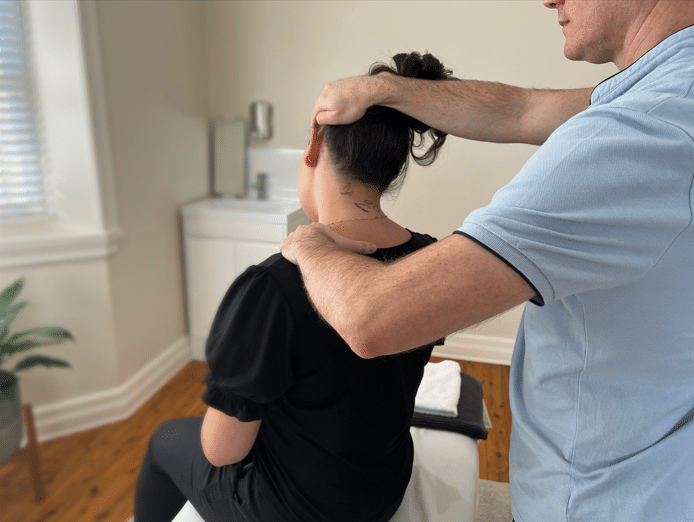
Spinal manipulative therapy (SMT) is one of the core tools a chiropractor uses. When your chiropractor performs an adjustment, they apply a specific, controlled force to a joint in your spine. The goal is to restore movement to joints that have become stiff or restricted. Think of it like opening a window that has been painted shut, the joint is still there, but it needs help moving freely again.
A 2024 randomised, placebo-controlled trial found that spinal manipulative therapy reduced chronic primary lower back pain and was accompanied by decreases in segmental mechanical sensitivity and pain catastrophising. This is an important finding because it suggests that SMT not only works on the joints, it also appears to influence how your nervous system processes pain signals. Jpain
A clinical practice guideline from the Canadian Chiropractic Guideline Initiative concluded that a multimodal approach, including spinal manipulation, active interventions, self-management advice, and exercise, is an effective treatment strategy for both acute and chronic lower back pain. The key phrase here is multimodal, meaning a combination of approaches, not just one technique in isolation. Evidence consistently shows that the best outcomes come from combining manual therapy with active rehabilitation and movement. PubMed
One of the strongest arguments for chiropractic care in desk workers is this: it does not just treat your symptoms. It addresses the underlying movement dysfunction caused by desk work. Your chiropractor assesses how your spine moves, identifies where restrictions exist, and applies targeted treatment to restore function.
The muscles around your lower back, including the quadratus lumborum, erector spinae, and deep multifidus, can become chronically tight when you sit for hours each day. This muscle tightness is not just uncomfortable. It actively limits your range of motion and contributes to the achy, heavy feeling in your lower back at the end of the workday.
Soft tissue therapy, which includes techniques like deep tissue massage, myofascial release, and trigger point therapy, targets this muscle tension directly. A 2025 randomised clinical trial found that deep tissue massage significantly improved lumbar range of motion across all movement planes in office workers with chronic lower back pain, with a moderate-to-large effect size. This shows that hands-on soft-tissue work can create real, measurable changes in how your lower back moves. nih
When your muscles are tight, they also compress the small joints of your spine, reducing the effectiveness of any other treatment you receive. Soft tissue therapy effectively prepares the tissues so that spinal adjustments can work more efficiently. Think of it like warming up a stiff leather glove before trying to open and close your hand, the glove moves far more freely once it has been worked.
Strength training improves core muscle strength, while flexibility exercises help rebalance and reduce muscle stiffness and tension, improving overall functional movement. Soft tissue therapy and exercise work together to address both the passive tightness and the active weakness that desk work creates in your lower back (Journal of Bodywork and Movement Therapies).
Here is something that surprises many people: rest is rarely the answer for desk-related lower back pain. Your lower back needs movement. It needs a load. The muscles that support your spine, particularly your deep stabilisers like the multifidus and transverse abdominis, need to be trained to do their job properly.
A randomised controlled study found that a supervised combined exercise programme including flexibility, strength, and balance training significantly reduced musculoskeletal pain duration and intensity by 43–70% in office workers, while also improving overall work capacity by 87%. These are striking numbers. They reinforce that movement is medicine, but the right kind of movement, applied at the right dose. nih
A 2025 network meta-analysis of exercise prescription variables for chronic lower back pain found that the combination of exercise type, frequency, duration, and period all significantly influenced clinical outcomes. This is the scientific argument for why a generic “do some stretches” approach is not enough. The dosage of your exercise matters. The type matters. The progression matters. Getting this right requires professional guidance nih
This is where your chiropractor plays a critical role. As a trained clinician, your chiropractor can assess your movement, identify your specific deficits, and prescribe exercises calibrated to your body’s current capacity. Too little exercise does not adapt. Too much triggers a flare. The correct dose produces change, less pain, better strength, more movement.
A chiropractic approach that combines spinal adjustments, soft tissue therapy, and targeted exercise is called a multimodal approach. This is not a trend. It is the direction that the best evidence points to.
A 2022 study found that multimodal pain management for lower back pain led to significant increases in lower-limb muscle strength across all measured muscle groups. Strength gains matter here because weak hips and legs increase the load transferred to your lumbar spine, a pattern that is extremely common in desk workers whose hip flexors and glutes have weakened from prolonged sitting nih
Research has confirmed that core stabilisation exercises combined with hip strengthening improve proprioception, balance, muscle thickness, and pain-related outcomes in patients with lower back pain. When your chiropractor works with you, they are not just treating the site of your pain. They are restoring the entire movement system, the communication between your muscles, joints, and nervous system, that desk work has slowly disrupted. Cureus
As we age, this becomes even more important. Muscle mass, joint mobility, and proprioceptive accuracy all decline with age. Age-related musculoskeletal disorders encompass a wide spectrum of conditions affecting muscles, bones, cartilage, and other tissues, resulting in substantial physical and functional limitations. Exercise has been established as an essential component in treating and slowing the musculoskeletal system’s age-related decline. Your chiropractor can prescribe exercise at the correct dosage to stimulate movement, preserve function, and reduce the compounding effects of ageing on a spine that has already been stressed by years of desk work. ihnih
The combination of spinal adjustments to restore joint mobility, soft tissue therapy to address muscle tightness, and individually prescribed exercise to rebuild strength and proprioception represents the most complete, evidence-informed approach to your lower back pain.

Desk work places your lower back under sustained load, flattens your natural spinal curve, tightens your muscles, and gradually disrupts the proprioceptive signals your spine relies on to protect itself. The result is the dull, achy lower back pain that so many office workers experience, and too often accept as normal. It is not normal, and it does not have to be permanent. A multimodal chiropractic approach, combining spinal manipulation, soft tissue therapy, and appropriately dosed exercise, has growing evidence supporting its use in reducing your pain, restoring your movement, and improving the long-term health of your spine. If your back has been speaking to you at the end of every workday, it may be time to listen and to get some expert help in answering it.

Scott has more than 20 years of clinical experience as a movement expert and musculoskeletal health professional. His thorough understanding of how pain affects your spine, joints, muscles, and total well-being is the result of significant academic study and many many years of clinical experience. Scott’s real interest in movement mechanics enables him to develop individualised care plans that summarise complex problems into clear, simple treatments, leading to quicker healing times. His friendly, attentive approach ensures that you not only comprehend but also feel supported throughout your treatment journey, allowing you to return to the things you like with restored confidence and vitality.