- 02 9712 1736
- [email protected]
- 212 Great North Road, Five Dock, NSW 2046
- Open 7 days a week

You may have recovered from an injury weeks or months ago. But something still doesn’t feel right. Your body aches. Your movement feels guarded, and your muscles stay tight no matter how much you stretch. The answer often lies in something invisible, your body’s internal positioning system, called proprioception. When injury disrupts this system, your brain receives faulty information about where your body is. This faulty information keeps your pain and tightness alive long after the original damage has healed. Understanding how this works is the first step toward real, lasting recovery.

Proprioception is your body’s ability to sense its own position, movement, and muscle effort. It is often called the “sixth sense.” You can walk down a dark hallway without looking at your feet. You can reach for a glass without watching your hand. These actions rely entirely on proprioception working silently in the background.
Inside your muscles, tendons, joints, and skin live tiny specialised receptors. These are called mechanoreceptors. One of the most important is the muscle spindle. Muscle spindles detect changes in muscle length and speed. Golgi tendon organs track tension in your tendons. Together, these receptors send a constant stream of signals to your brain. Researchers define proprioception as encompassing signals from mechanoreceptors in the skin, muscles, tendons, and joint capsules (Sakai et al., 2022).
Think of your brain as an air traffic control tower. Your proprioceptors are like radar systems at every joint and limb. They report your body’s position moment by moment. The tower uses this data to direct every movement you make. When this system works accurately, movement feels natural and effortless. Your muscles activate in the right order. Your posture adjusts automatically. Everything flows because the information loop between your body and brain is intact.
What makes this system remarkable is its speed and precision. Your proprioceptors fire before you consciously decide to move. They allow your body to respond to changes in surface or load before pain signals even register. When the system is working well, you move with confidence and ease. When it breaks down, even simple tasks begin to feel uncertain.
Your injury does not just damage tissue. It disrupts the communication system between your body and brain. Swelling, scar tissue, and changes to nerve endings alter how your mechanoreceptors fire. Your brain starts receiving inaccurate signals. Research confirms that proprioception is significantly impaired following musculoskeletal injury (Peng et al., 2021). People with neck pain show measurable errors in joint position sense. Their brains misjudge where the neck is in space.
Think of it like a GPS that has lost satellite connection. It keeps displaying your last known location. It cannot update in real time. Your brain does something similar after your injury. It tries to fill the gaps with protective responses. One of those responses is muscle tightness.
Your muscles do not tighten after injury simply because they are “knotted.” They tighten because your brain orders them to. When proprioceptive signals become unreliable, the brain increases muscle tone around vulnerable areas. This is a protective strategy. Your nervous system is guarding the injured region from further harm. The problem is that chronic tightness further reduces the quality of proprioceptive signals. It creates a self-reinforcing loop of tightness, restricted movement, and pain.
At the receptor level, this process is more complex than it first appears. Joint damage and inflammation alter the firing thresholds of your mechanoreceptors. Some become hypersensitive. Others fall silent. Research has confirmed that proprioceptive deficits in musculoskeletal conditions are closely linked to pain severity (Salamanna et al., 2023). These deficits are not passive side effects of your pain. They actively worsen it by feeding your brain faulty positional data. The more inaccurate the data, the more protective your nervous system becomes.
You may have noticed something puzzling after your injury. Your dull, achy pain doesn’t stay in one spot. It spreads. It varies day to day, and it seems disconnected from anything visible on a scan. This is a hallmark of what happens when your brain’s body map becomes unreliable over time.
When proprioceptive errors persist long enough, your nervous system begins to change. The brain amplifies incoming pain signals. It starts interpreting ordinary sensory input as threatening. Researchers introduced the term “nociplastic pain” to describe this altered state (Nijs et al., 2021). Nociplastic pain occurs even when tissue damage is no longer present. Your pain system has essentially been recalibrated to stay on high alert.
Experiencing persistent dull and achy pain may reflect exactly this pattern. Your nervous system has been shaped by months of inaccurate proprioceptive input. It has learned to stay in a defensive mode. Restricted movement means your brain receives less and less fresh positional data. The body map stays scrambled. Your pain continues.
This is not a psychological problem. It is a neurological one. It requires different strategies than rest or passive treatment alone. The key insight from pain science is this: chronic proprioceptive disruption and central sensitisation form a mutually reinforcing cycle. Each one makes the other worse. Restoring accurate proprioceptive feedback requires active, targeted intervention. Passive waiting allows the cycle to deepen.
Your proprioceptive system is not permanently damaged by injury. It is trainable. This is one of the most encouraging findings in recent research. The key is delivering the right type of movement at the right dose.
Passive stretching alone cannot re-educate your proprioceptors. Rest, over time, makes things worse. Your mechanoreceptors need to be actively stimulated to send updated signals to your brain. Strength training is particularly powerful here. When muscles are loaded progressively, muscle spindle activity increases. Your brain receives fresh, high-quality positional data. Your body map gradually recalibrates.
Research supports this directly. Proprioceptive training significantly improved joint position sense, pain, and function in people with knee osteoarthritis (Wang et al., 2021). Proprioceptive training outperformed passive interventions on every key measure. Clinically, people who move carefully, progressively, and consistently recover better than those who do not.
The critical variable, however, is dosage. How much exercise is enough? How intense? How often? These questions matter enormously. Too little stimulus fails to challenge the nervous system meaningfully. Too much can trigger a pain flare and reinforce protective responses. Getting the dosage right requires clinical assessment, not guesswork.
A 2024 systematic review with meta-analysis confirmed this more precisely. Exercise, particularly motor control exercise, significantly improved central sensitisation outcomes in people with chronic musculoskeletal pain (Chen et al., 2024). Motor control exercise specifically improved conditioned pain modulation. This is your brain’s own mechanism for inhibiting pain signals. The right movement prescription does not just build your strength. It changes how your brain processes pain.
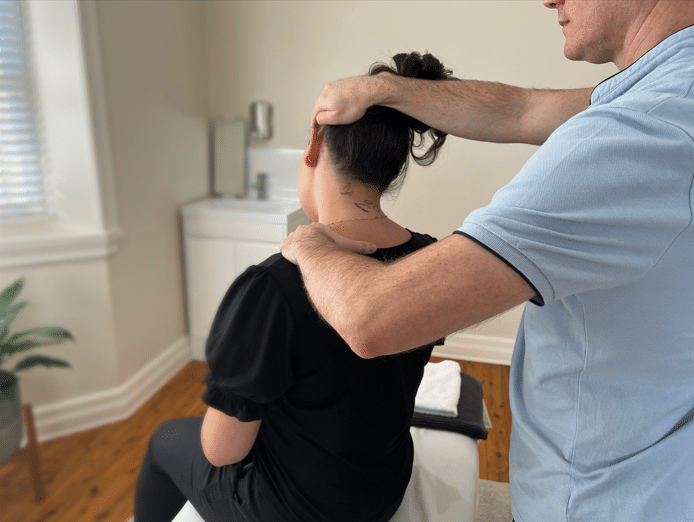
A chiropractor working across your full movement system can make a meaningful difference here. A multimodal approach combines soft tissue therapy, spinal adjustments, and targeted exercise. Each component addresses proprioception from a different angle. Together, they create a compounding effect that no single intervention achieves alone.
Soft tissue therapy targets the muscle guarding that develops after your injury. Chronically tense muscle tissue has altered mechanoreceptor sensitivity. Manual soft tissue techniques help release this tension. They improve local circulation and restore more normal muscle spindle function. When your soft tissue responds, your proprioceptive signals become cleaner and more accurate.
Spinal adjustments target joint dysfunction directly. A 2024 randomised controlled trial tested this in Scientific Reports. Adjustments applied to clinically identified dysfunctional spinal segments significantly altered sensorimotor integration in the brain (Niazi et al., 2024). Crucially, the same effect was not seen when adjustments were applied to non-dysfunctional segments. This finding matters. It confirms that precise clinical targeting, not just any manual force, produces measurable neurophysiological change.
A 2026 systematic review reinforced this further. Cervical spinal manipulation produced significant improvements in joint position sense error in people with chronic neck pain (Hadjisavvas et al., 2026). Effect sizes were large in symptomatic populations. It is important to note that this evidence base is still growing. Larger, longer trials are needed. However, the current evidence supports spinal manipulation as a meaningful part of a proprioceptive rehabilitation plan. This is especially true when combined with other approaches.
Targeted exercise prescription then consolidates and extends these neurological gains. Your chiropractor is trained to assess your specific movement deficits. They can prescribe a progressive exercise dosage calibrated to your nervous system’s current state. This is not a generic exercise handout. It is a stimulus designed to retrain your proprioceptors and build strength around vulnerable joints. It guides your nervous system away from its protective state, gradually and safely.
The evidence for combining all three approaches is compelling. A structured review of randomised trials from 2019 to 2025 found that multimodal programmes consistently outperformed single-modality care. Combining manual therapy, soft tissue treatment, and exercise produced greater pain reduction and functional improvement than any one approach alone (Simati et al., 2025). Your pain is not a single problem with a single solution. A chiropractor who understands this is well-placed to help you.

Proprioception is your body’s real-time positioning system. After your injury, this system is disrupted in ways that go far beyond the original tissue damage. Faulty signals create muscle tightness, restricted movement, and dull, achy pain. Over time, persistent proprioceptive errors can sensitise your nervous system and amplify your pain response. The encouraging reality is that this system is adaptable. Movement, strength training, and precise manual care all help restore accurate proprioceptive signalling. A chiropractor taking a multimodal approach, combining soft tissue therapy, spinal adjustments, and prescribed exercise, gives your brain the best possible chance of updating its body map. When that map is accurate again, your pain eases, your movement frees up, and your strength returns.

Scott has more than 20 years of clinical experience as a movement expert and musculoskeletal health professional. His thorough understanding of how pain affects your spine, joints, muscles, and total well-being is the result of significant academic study and many many years of clinical experience. Scott’s real interest in movement mechanics enables him to develop individualised care plans that summarise complex problems into clear, simple treatments, leading to quicker healing times. His friendly, attentive approach ensures that you not only comprehend but also feel supported throughout your treatment journey, allowing you to return to the things you like with restored confidence and vitality.