- 02 9712 1736
- [email protected]
- 212 Great North Road, Five Dock, NSW 2046
- Open 7 days a week
If you have been putting off booking an appointment, safety is probably the reason. Perhaps you read a frightening story online. Perhaps a friend warned you about neck adjustments. That question deserves a straight answer, not a sales pitch. So here is what the research actually shows. We will cover what is common, what is rare, and what genuinely raises your risk. We will also explain how we make decisions about your care.
Chiropractic is a regulated allied health profession. It focuses on your muscles, joints and nerves, and on how you move. This information also gives us in sight into your overall health and how we can help you to feel better.
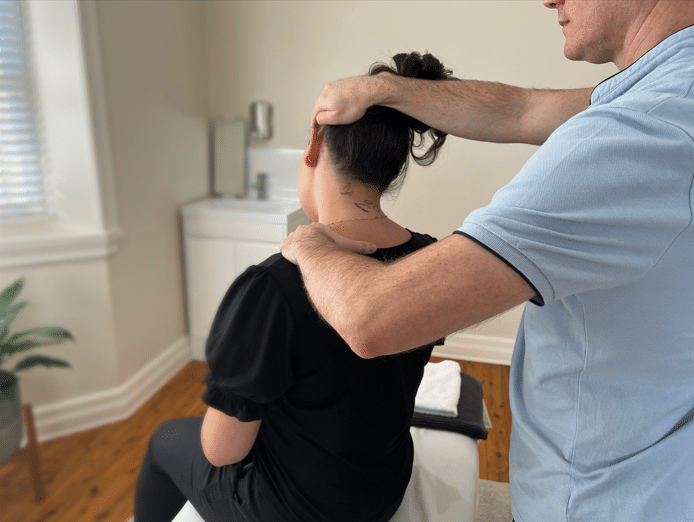
The best-known technique is the spinal adjustment. This is a quick, controlled push applied to a joint. You might hear a pop. That sound is gas shifting inside the joint fluid. Nothing is cracking.
Adjustments are only one tool, though. We also use soft tissue therapy to settle muscle tightness. We prescribe exercise. We talk through your work, your sleep and your daily life load.
People come to us with back pain, neck pain, headaches, sciatica, joint stiffness, sporting injuries and other health concerns. Some arrive with a dull, achy pain they cannot explain. Others arrive after a clear moment of injury.
Let us start with what you are most likely to actually feel.
A large review of trials in chronic low back pain found that most side effects were musculoskeletal. They were temporary, and mild to moderate in severity. Think soreness, stiffness, or feeling tired that evening.
These mild reactions are not rare. Researchers estimate they follow somewhere between 23% and 83% of treatments. That range is wide because studies ask about them so differently.
This matters for you after treatment. If you leave or wake the next day feeling a bit tender, that is expected. It should settle within a day or two. If soreness lasts longer or your pain worsens, tell us. That is information, not failure. It usually means we adjust the force, the technique, or the amount of exercise we gave you.
Serious harm from chiropractic care is uncommon. One study reviewed 960,140 treatment sessions across 30 clinics. Only two severe events (rib fractures) occurred. That works out at roughly 0.2 events per 100,000 sessions. No strokes were recorded, and nothing life-threatening happened.
That study has limits. It was retrospective, and it relied on a complaints log. Rare events are hard to count even in samples that large.
The concern people usually raise is stroke. It relates to cervical artery dissection, a small tear in an artery in the neck. It is rare, and it can cause a stroke.
The evidence here is genuinely mixed, so we will not pretend otherwise. A large study of insurance records reached different answers depending on the comparison group. Set against people who had a stroke without a dissection, dissection patients had more often seen a chiropractor recently. Set against the general population, and against their own history six months earlier, they had more often seen a doctor. The authors concluded the link is probably not causal.
The likely explanation is uncomfortable but important. A dissection that has already begun causes neck pain and headache. Those symptoms send people to a clinician, whoever that clinician happens to be.
A 2025 review of dissection risk factors reached a cautious verdict. Minor trauma was identified as a risk factor, but the certainty of that evidence was low. Migraine carried stronger evidence than physical triggers did. Most studies in the field carried a high risk of bias.
So the honest position is this. The absolute risk is very low. Causation is not established. Major stroke organisations still recommend that clinicians discuss it with you. We do, before we touch your neck.
Safety is rarely about the technique alone. It is about the technique meeting the right person.
In that 960,140-session study, both severe events were rib fractures. Both occurred in women over 60 with osteoporosis. Both followed a firm thrust to the mid-back. Forceful adjustment is generally avoided in people with reduced bone density.
That is why our history-taking can feel long. We ask about osteoporosis, long-term steroid use, cancer, previous fractures and blood thinners. We ask about sudden severe headache, unexplained weight loss, fevers, and changes to bladder or bowel control. We ask about progressive muscle weakness or numbness. Those answers change what we do, and sometimes they mean we refer you rather than treat you.
A diagnosis is not automatically a red light. Disc bulges, scoliosis, TMJ pain, frozen shoulder and vertigo all sit in our caseload. What changes is how we work. Lower-force options exist for almost every region. We can mobilise a joint gently, use a drop-piece table, use an instrument, or work only with soft tissue. Nobody should feel they must accept a technique they are not comfortable with.
Here is where the evidence gets interesting, and where we want to be careful with you.
Adjustments on their own are not magic. That same large review found spinal manipulation produced results broadly similar to other recommended treatments for chronic low back pain. Not worse. Not dramatically better.
Soft tissue therapy has a similar story. A 2024 review of massage research found that most conclusions rested on low or very low certainty evidence. The evidence is not absent. It is simply not strong.
What the literature supports more consistently is the combination. A review of chiropractic spinal manipulation concluded that the strongest support existed for multimodal approaches, particularly manipulation combined with exercise. For neck pain, manipulation is recommended as part of a broader package rather than on its own.
We should be upfront that this particular review was a narrative one, not a meta-analysis. Clinically, the logic is straightforward. Hands-on work can reduce pain and stiffness in the short term. That window makes movement tolerable. Movement is what changes things over months.
This is also why we may ask you to balance on one leg with your eyes closed. That tests proprioception, your body’s sense of where it is in space. Persistent pain often blunts it. If your balance strategy has quietly changed, loading you heavily is a poor idea. We would rather rebuild the control first.
Exercise has a dose, exactly like medication. More is not automatically better.
A 2024 analysis of 82 trials mapped this out for chronic low back pain. The relationship between exercise and pain relief followed a U-shaped curve. Meaningful improvement appeared at around 520 MET-minutes per week. The strongest effect appeared near 920 MET-minutes. Beyond that, benefit did not keep climbing. The certainty of that evidence ranged from very low to moderate, so treat the numbers as a guide.
For you, this means the prescription is the skill. Too little exercise achieves nothing. Too much flares your symptoms and destroys your confidence. Our job is to find the amount your tissues can currently handle, then raise it as they adapt.
Now the part we want to be precise about, because it is often oversold.
Regular physical activity does improve measures of nervous system balance, such as heart rate variability. That evidence comes largely from cardiac and general exercise research, not from chiropractic patients.
The adjustment itself is a different question. A randomised trial added spinal manipulation to home stretching exercises over two weeks. It found no significant difference in any heart rate variability measure compared with stretching alone.
So we will not tell you that an adjustment resets your nervous system. The calming effect appears to come from the exercise. It also comes from reducing the pain that keeps your system on alert. The hands-on work helps you get moving. The movement does the physiological work.
Chiropractic care is not risk-free, and no honest clinician will tell you it is. Mild soreness is common and short-lived. Severe harm is very rare. Your individual history, particularly bone health, matters far more than the label on your diagnosis.
The strongest evidence supports a combined approach. Soft tissue work, adjustment and well-dosed exercise together, rather than any one of them alone.
Ask us questions. Tell us what worries you. A good conversation is part of safe care.
This article is general information only. It is not a substitute for individual assessment by a qualified health practitioner.
Biller, J., Sacco, R. L., Albuquerque, F. C., Demaerschalk, B. M., Fayad, P., Long, P. H., Noorollah, L. D., Panagos, P. D., Schievink, W. I., Schwartz, N. E., Shuaib, A., Thaler, D. E., & Tirschwell, D. L. (2014). Cervical arterial dissections and association with cervical manipulative therapy: A statement for healthcare professionals from the American Heart Association/American Stroke Association. Stroke, 45(10), 3155–3174. https://doi.org/10.1161/STR.0000000000000016
Chu, E. C.-P., Trager, R. J., Lee, L. Y.-K., & Niazi, I. K. (2023). A retrospective analysis of the incidence of severe adverse events among recipients of chiropractic spinal manipulative therapy. Scientific Reports, 13(1), 1254. https://doi.org/10.1038/s41598-023-28520-4
El-Malahi, O., Mohajeri, D., Mincu, R., Bäuerle, A., Rothenaicher, K., Knuschke, R., Rammos, C., Rassaf, T., & Lortz, J. (2024). Beneficial impacts of physical activity on heart rate variability: A systematic review and meta-analysis. PLOS ONE, 19(4), e0299793. https://doi.org/10.1371/journal.pone.0299793
Galaasen Bakken, A., Eklund, A., Hallman, D. M., & Axén, I. (2021). The effect of spinal manipulative therapy and home stretching exercises on heart rate variability in patients with persistent or recurrent neck pain: A randomized controlled trial. Chiropractic & Manual Therapies, 29(1), 48. https://doi.org/10.1186/s12998-021-00406-0
Gevers-Montoro, C., Provencher, B., Descarreaux, M., Ortega de Mues, A., & Piché, M. (2021). Clinical effectiveness and efficacy of chiropractic spinal manipulation for spine pain. Frontiers in Pain Research, 2, 765921. https://doi.org/10.3389/fpain.2021.765921
Jacobs, W., Wright, D. S., Pohlman, K. A., Rosenbaum, R., Hutten, B. A., Scholten-Peeters, G. G. M., Haldeman, S., Ket, J. C. F., & Rubinstein, S. M. (2025). Risk factors for cervical artery dissection: A systematic review with meta-analysis. Stroke and Vascular Neurology. Advance online publication. https://doi.org/10.1136/svn-2025-004186
Liang, Z., Tian, S., Wang, C., Zhang, M., Guo, H., Yu, Y., & Wang, X. (2024). The best exercise modality and dose for reducing pain in adults with low back pain: A systematic review with model-based Bayesian network meta-analysis. Journal of Orthopaedic & Sports Physical Therapy, 54(5), 315–327. https://doi.org/10.2519/jospt.2024.12153
Mak, S., Allen, J., Begashaw, M., Miake-Lye, I., Beroes-Severin, J., De Vries, G., Lawson, E., & Shekelle, P. G. (2024). Use of massage therapy for pain, 2018–2023: A systematic review. JAMA Network Open, 7(7), e2422259. https://doi.org/10.1001/jamanetworkopen.2024.22259
Rubinstein, S. M., de Zoete, A., van Middelkoop, M., Assendelft, W. J. J., de Boer, M. R., & van Tulder, M. W. (2019). Benefits and harms of spinal manipulative therapy for the treatment of chronic low back pain: Systematic review and meta-analysis of randomised controlled trials. BMJ, 364, l689. https://doi.org/10.1136/bmj.l689
Swait, G., & Finch, R. (2017). What are the risks of manual treatment of the spine? A scoping review for clinicians. Chiropractic & Manual Therapies, 25, 37. https://doi.org/10.1186/s12998-017-0168-5
Whedon, J. M., Petersen, C. L., Schoellkopf, W. J., Haldeman, S., MacKenzie, T. A., & Lurie, J. D. (2023). The association between cervical artery dissection and spinal manipulation among US adults. European Spine Journal, 32(10), 3497–3504. https://doi.org/10.1007/s00586-023-07844-9

Scott has more than 20 years of clinical experience as a movement expert and musculoskeletal health professional. His thorough understanding of how pain affects your spine, joints, muscles, and total well-being is the result of significant academic study and many many years of clinical experience. Scott’s real interest in movement mechanics enables him to develop individualised care plans that summarise complex problems into clear, simple treatments, leading to quicker healing times. His friendly, attentive approach ensures that you not only comprehend but also feel supported throughout your treatment journey, allowing you to return to the things you like with restored confidence and vitality.