Understanding Your Injury: Movement, Not Just Rest
A concussion is a temporary disruption to how your brain functions, usually from a knock to the head or a whiplash-type force through your neck. Your brain isn’t bruised or bleeding in a typical concussion, think of it more like a phone that’s had its software glitch, not its hardware broken. That’s good news, because it means the system can reboot with the right inputs. bjsm.bmj
For the first 24 to 48 hours, gentle rest is still sensible while we watch for any red-flag symptoms. After that early window, the international consensus on concussion in sport recommends a gradual return to light activity rather than prolonged rest. We often see patients who were told to avoid all movement for weeks, and by the time they reach us, deconditioning and neck stiffness have become bigger problems than the original injury. bjsm.bmj
Why Your Neck Might Be Part of the Problem
Here’s something that surprises most patients: your neck and your brain injury are closely linked. The forces that jolt your brain during a concussion almost always jolt your cervical spine too, and this can produce dizziness, headache, and a dull, achy pain at the base of your skull that mimics or worsens concussion symptoms. discovery.researcher
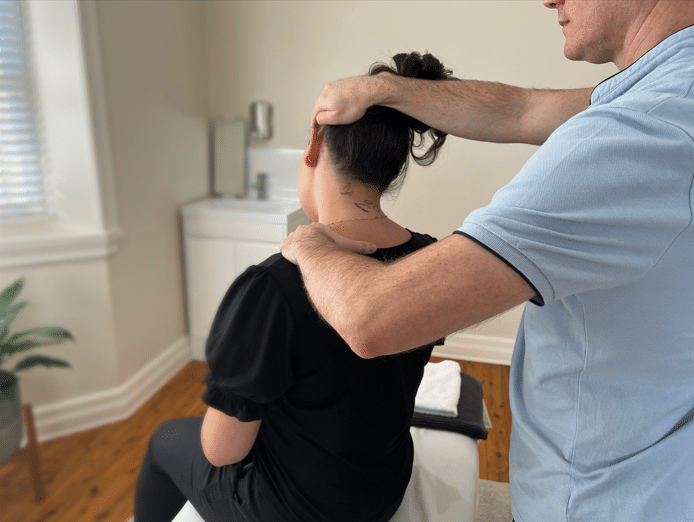
A landmark randomised controlled trial found that young patients with persistent dizziness, neck pain, or headache after a sports concussion who received combined cervical spine and vestibular (inner-ear balance system) physiotherapy were nearly four times more likely to be medically cleared to return to sport within 8 weeks than those who received standard care alone, 73% versus just 7%. This is why we assess this by checking your neck’s range of motion and joint position sense alongside your concussion symptoms, not as an afterthought. When a clinician gently mobilises the joints in your upper neck, we’re not just chasing muscle tightness , we’re addressing a genuine driver of your dizziness and headache. pubmed.ncbi.nlm.nih
Proprioception, Balance, and Retraining Your Brain
Proprioception is your body’s sense of where it is in space, and it takes a real hit after concussion. Your neck contains dense clusters of receptors that feed this information to your brain, and when those receptors are disrupted, you might notice you feel unsteady, clumsy, or seasick in busy environments.
This is precisely why a clinician might ask you to balance with your eyes closed or track a moving target with your head still. These aren’t arbitrary tests, they’re targeted ways to retrain the proprioceptive and vestibular systems working together. A systematic review of randomised trials found vestibular rehabilitation therapy produced a meaningful reduction in dizziness handicap scores after concussion, alongside improvements in quality of life and mobility, though the authors noted real heterogeneity across the studies and called for larger trials to confirm the size of the benefit. Other reviews have described the evidence as promising but still developing, which is an honest reflection of where the science currently sits. pubmed.ncbi.nlm.nih+2
The Case for a Multimodal Chiropractic Approach
You might expect a single fix for a concussion, but the strongest evidence actually points to combining approaches. Soft tissue therapy, spinal adjustments, and targeted exercise appear to work better together than any one intervention alone, particularly for concussions where neck involvement is present.
In the trial mentioned above, the intervention group received manual therapy to the cervical spine plus vestibular exercises, layered on top of postural education and graded exertion, not soft tissue work or adjustment in isolation. Separately, a retrospective analysis of patients with persistent post-concussion symptoms found that those who received cervical spine treatment, including manual therapy, showed measurable improvement in symptoms such as headache and dizziness, supporting the idea that addressing the neck is a legitimate and evidence-informed part of concussion care. A more recent feasibility trial is now testing whether starting this cervical-focused care earlier, rather than waiting weeks, improves outcomes further, which tells you this is still an active area of research rather than settled fact. pubmed.ncbi.nlm.nih+2
On the exercise side specifically, evidence is now strong enough to shift clinical guidance. A randomised trial found that a structured aerobic exercise program starting within the first week after concussion led to faster return to symptom-free status and faster medical clearance compared with usual care. A systematic review of nine randomised trials concluded that supervised, moderate-to-high-intensity aerobic exercise for 20 minutes, three to five times weekly, may meaningfully reduce concussion symptoms, particularly when started early in recovery. This is where dosage matters clinically; too little movement and you stall your recovery, too much too soon and you can flare symptoms, so we assess this by gradually building your heart rate exposure and tracking your response session by session. journals.plos+1
Movement, Low Mood, and Managing the Stress Response
Concussion doesn’t just affect your body, it affects how you feel emotionally, and that connection matters for your recovery. Large studies show anxiety and depressive symptoms are common after concussion, with one recent study of over 1,600 patients finding 45% screened positive for meaningful anxiety symptoms and 61% for depressive symptoms in the weeks following injury. Longer-term data suggests the risk of developing a diagnosable anxiety or depressive disorder stays elevated well beyond the first year. pubmed.ncbi.nlm.nih+1
Exercise has one of the best-supported roles here, and this is where chiropractic care linking movement to your recovery becomes genuinely relevant, not just a nice add-on. A major systematic review and meta-analysis of randomised trials published in The BMJ found exercise produced moderate reductions in depressive symptoms, with a clear dose-response relationship, more vigorous exercise, prescribed appropriately, tended to help more. A large dose-response meta-analysis in JAMA Psychiatry similarly found even modest amounts of physical activity were associated with meaningfully lower depression risk, with the biggest gains seen moving from no activity to some activity at all. This is where getting your exercise dosage right matters for your mental state as much as your physical symptoms. We assess this by checking what you can tolerate without provoking symptoms, then building from there, because under-dosing exercise leaves this benefit on the table entirely. jamanetwork+1
There’s also emerging, though still preliminary, evidence connecting neck-focused manual therapy directly to your body’s physical stress response. A small proof-of-concept trial found that mobilising specific segments of the cervical spine produced measurable changes in stress hormone levels and heart rate variability, markers of your autonomic nervous system, in people with persistent post-concussion symptoms. I want to be upfront that this was a small trial without a placebo control, so I see it as a plausible mechanism worth watching rather than settled proof that a chiropractic adjustment directly reduces your stress response. pmc.ncbi.nlm.nih
Achy Pain, Tightness, and What Normal Recovery Feels Like
It’s normal to notice muscle tightness through your neck, shoulders, and upper back after a concussion, alongside a dull, achy pain that comes and goes with activity. This often reflects real biomechanical changes. Your muscles guard the injured area, your posture shifts to avoid discomfort, and unused muscles gradually lose strength and flexibility.
I often see this pattern in patients weeks after their initial injury, once the crisis has passed but the compensations remain. Addressing these secondary issues through soft tissue work and progressive strengthening isn’t cosmetic, it removes ongoing sources of pain and sensory input that can keep your symptoms simmering longer than necessary.