What Is Fascia and Why Should You Care About Fascial Tightness?
Let me start with something simple. Fascia is a thin, stretchy tissue that wraps around everything inside your body. It surrounds your muscles, bones, nerves, and even your organs. Think of it like cling wrap around every part of you.
For a long time, scientists thought fascia was just packing material. They believed it only filled empty spaces between your other tissues. But recent research has completely changed that view. We now know fascia is a dynamic, living tissue that can sense and transmit pain.
Your fascia contains thousands of tiny nerve endings. These nerve endings can detect pressure, temperature, and pain. In fact, fascia may contain more pain-sensing nerves than your muscles do. That means when your fascia gets tight or damaged, you feel it.
How the Fascial Continuum Connects Your Entire Body
Here is where things get really interesting. Your fascia does not just wrap individual muscles. It connects them all together in continuous chains. Scientists call this the “fascial continuum.”
Think of it like a spider web. If you pull on one corner, the whole web moves. Your body works the same way. Tension in one area creates tension in another.
Research has confirmed that these fascial chains are real. One well-studied chain is called the Superficial Back Line. It runs from the bottom of your feet all the way up your back. It connects your plantar fascia, calf muscles, hamstrings, and lower back.
This means tightness in your calf can pull on your lower back. A problem in your foot can create pain in your pelvis. Your body is truly all connected through this fascial web.
Why Fascial Tightness Creates That Dull, Achy Pain
You know that dull, achy pain that seems hard to pinpoint? The kind that spreads across your lower back or upper back? That is often your fascia talking to you.
When fascia becomes damaged or inflamed, it goes through changes. The layers start to stick together. Scientists call this process “densification.” The smooth, gliding layers of tissue become thick and stiff.
Healthy fascia slides freely between your muscles. Damaged fascia loses that ability. This creates fascial tightness that restricts your movement. It also activates those pain-sensing nerve endings I mentioned earlier.
This explains why your pain often feels widespread rather than sharp. Fascial pain tends to be dull, achy, and hard to locate precisely. It is different from the sharp pain of a pulled muscle.
Your Lower Back, Pelvis, Hips and Calf Muscles: A Fascial Connection
I want you to understand a connection that surprises many patients. Your lower back, pelvis, hips, and calf muscles are all linked by fascia.
The thoracolumbar fascia is a large sheet of connective tissue in your lower back. It connects to your gluteus maximus in your hip. From there, fascia continues down through your hamstrings to your calf muscles. It even reaches your plantar fascia on the bottom of your feet.
Research has shown that pulling on the hamstring tendon causes movement in the thoracolumbar fascia. This means tension travels between your legs and spine. When your calf is tight, that tension travels upward through the fascial chain.
This is why your lower back pain may not actually start in your lower back. Your injury might begin with tight calf muscles or stiff hips. The fascial continuum then transmits that tension to your spine. Understanding this connection changes how we approach your treatment.
I see this pattern regularly in my clinic. A patient comes in with lower back pain. When I assess their whole body, I find fascial tightness in their calves or hips. Treating only the lower back would miss the real cause.
Your Shoulder, Upper Back and Neck: Another Fascial Chain
The same principle applies to your upper body. Your shoulder, upper back, and neck are tightly linked through fascia.
The cervical fascia in your neck connects directly to the fascia of your upper back. From there, it continues into the shoulder region. Key muscles like the trapezius have fascial connections that span all three areas.
Research has even found a fascial chain connecting your neck muscles to the muscles around your eyes. Scientists call this the neck-eye myofascial continuum. This may help explain why neck tension often causes headaches.
When you sit at a desk all day, your shoulder fascia tightens. That fascial tightness pulls on your upper back and neck. Over time, this creates that familiar dull pain between your shoulder blades. It can also cause stiffness and reduced movement in your neck.
Your injuries in this area often develop slowly. The fascial continuum gradually accumulates tension over weeks and months. By the time you feel pain, the problem involves your whole upper chain.
How Fascial Injuries Happen and Why Movement Matters
Your fascia responds to how you use your body every day. Too little movement is just as harmful as too much.
When you sit still for long periods, your fascial layers start to stick together. The smooth, slippery substance between layers becomes thick and viscous. This is why you feel stiff after sitting at a desk all day.
On the other hand, sudden overloading can also damage your fascia. When you increase your exercise too quickly, your fascia cannot adapt fast enough. This can lead to injuries in your tendons and surrounding tissues.
The key is finding the right balance. Your fascia needs regular, varied movement to stay healthy. It needs to be loaded gradually to build strength. This is where proper guidance makes a real difference.
How a Multimodal Chiropractic Approach Can Help Your Fascial Pain
As a chiropractor, I use a multimodal approach to treat fascial problems. This means I combine several evidence-based treatments together. Research supports this combined approach for the best results.
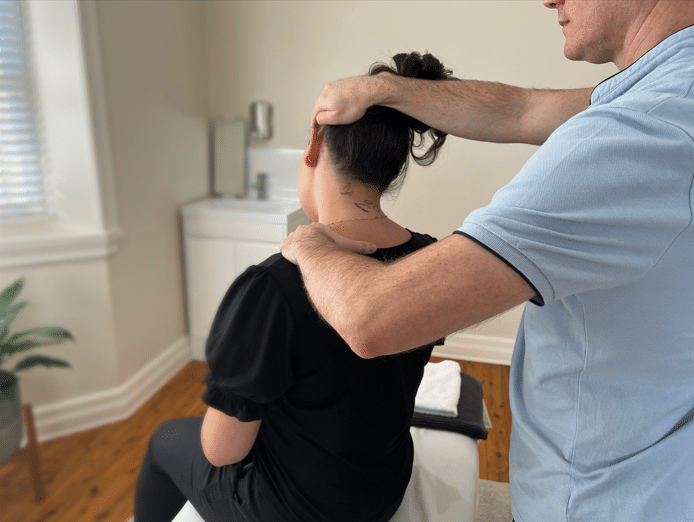
Soft tissue therapy targets your fascial tightness directly. Hands-on techniques help restore the sliding between fascial layers. This reduces that dull, achy pain and improves your movement. Research has shown fascial manipulation can reduce pain in musculoskeletal conditions.
Chiropractic adjustments address the joints within your fascial chains. When joints are restricted, they create extra tension on surrounding fascia. Restoring joint movement helps the whole chain function better. Clinical guidelines recommend spinal manipulation for lower back and neck pain.
Prescribed exercise is where lasting change happens. Your fascia and tendons respond powerfully to the right kind of loading. But the dosage matters enormously. Too much exercise can make things worse. Too little will not create the adaptation you need.
This is especially important for tendon injuries. Research has shown that progressive resistance exercise is the most effective treatment for tendinopathy. Higher intensity loading with external resistance produces better results than bodyweight exercise alone.
However, the exercise must be prescribed carefully. Studies have found that exercising less frequently, with adequate rest between sessions, produces better outcomes. This allows your tendons and fascia time to recover and adapt.
As your chiropractor, I can prescribe the correct exercise dosage for your specific condition. I consider your pain levels, your current strength, and your goals. Getting this dosage right is critical for tendon healing and fascial health.